
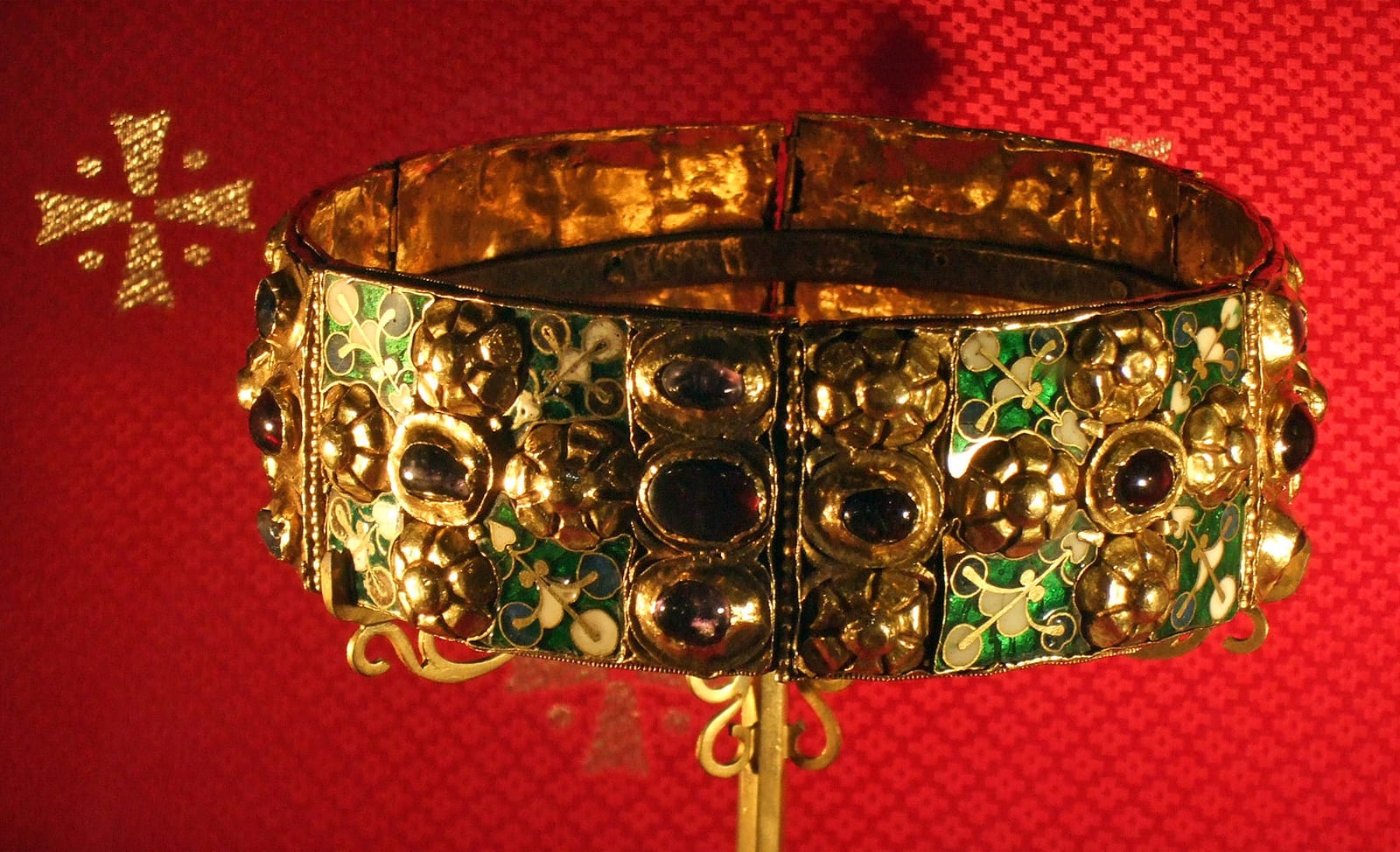
The Iron Crown (Corona Ferrea) of Lombardy is a Byzantine-workmanship diadem of gold plates studded with garnets and enamels, dated by modern examination to the fourth or fifth century AD, with a repair band added in the ninth. The inner metal band that gives the crown its name — a thin, black-iron circlet on the interior — is, according to a tradition attested from the ninth century onward, forged from one of the nails of the True Cross that St. Helena of Constantinople gave to her son Emperor Constantine.
The crown was given to the Cathedral of Monza by the Lombard queen Theodelinda about 590 AD. It has been used at the coronation of over thirty-four sovereigns — including Charlemagne as King of the Lombards (April 15, 774), Otto I (961), Emperor Charles V (February 22, 1530 at Bologna), Napoleon I (May 26, 1805 at the Milan Duomo), and Ferdinand I of Austria (September 6, 1838).
The crown survived the Napoleonic looting of Monza in 1859 by being transferred to the Habsburg treasury in Vienna, from which Emperor Franz Josef returned it after the Third Italian War of Independence in 1866. During World War II it was walled up behind masonry in the Chapel of Theodelinda at Monza Cathedral to protect it from Allied bombing and Nazi confiscation; it was recovered intact in 1946. In modern X-ray examinations (1985 and 1993 by Prof. Luigi Vigotti of the University of Milan), the interior band was determined to be silver — not iron — but the crown remains at Monza in continuous public veneration.