
Miguel Juan Pellicer Blasco was baptised at Calanda on 25 March 1617, the second of eight children of poor farmers. In the last days of July 1637, working for an uncle near Castellón de la Plana, he fell from a mule cart loaded with wheat and a wheel passed over his right leg, breaking the tibia. He was admitted to the Hospital Real in Valencia on 3 August, then made for Zaragoza, entering the Hospital Real y General de Nuestra Señora de Gracia in the first days of October. By then, in the words of the process, the leg was "muy mala, flemorizada y dañada, y se le puso negra."
The surgeons, led by the licentiate Juan de Estanga, professor of surgery at the university, in the last days of October 1637 gave him a drink and cut the leg off "cuatro dedos más abajo de la rodilla", cauterising the stump while he called on Our Lady of the Pillar. A surgical apprentice, Juan Lorenzo García, carried the severed leg to the chapel where the dead were laid out and buried it in the hospital cemetery. Discharged in the spring of 1638 with a wooden leg and a crutch, Pellicer was licensed to beg at the door of the Pilar. He heard Mass daily in the Santa Capilla and anointed the stump with oil from the lamps that burned before the image. Estanga thought the oil bad for the wound but said nothing, rather than take away his devotion.
In March 1640 he went home to Calanda, by donkey from Samper de Calanda. On Thursday 29 March two companies of cavalry were billeted in the town and a soldier had his bed. That evening, saying the stump ached, he took off the wooden leg and lay down at the foot of his parents' bed on a pannier and a hide, under a cloak because they had nothing else to give him. Between ten and eleven, after the neighbours Miguel Barrachina and his wife had gone home, he commended himself to the Virgin and fell into a deep sleep. A quarter of an hour later his parents came in with a candle, noticed "una fragancia y olor suave y no acostumbrado", and saw two feet sticking out from under the cloak, the cot being short. Roused with difficulty, he said he had been dreaming he was in the Santa Capilla anointing his leg. He told them to look for the marks he knew: the scar of the fracture on the shin, the scar of a boil on the calf, two scratches from a rosemary bush on the hillside. All three were there. At first the toes were curled and the leg purplish; from the third day it had its warmth and he could move the foot.
The vicar of Calanda, Mosén Jusepe Herrero, came the next morning with half the town, and on 2 April the royal notary Miguel Andreu of Mazaleón drew up a public act. At the petition of the Jurados — the city council of Zaragoza — the canonical process opened before the vicar general Juan Perat on 5 June 1640. Estanga swore that he had cut the leg off himself; his assistant Diego Millaruelo, the apprentice who had buried it, the hospital staff, the parish clergy of Calanda, the town's justicia and jurors, the neighbours and the parents all deposed under oath — some two dozen witnesses (twenty-four in Messori's count, twenty-five in the Cabildo's). On 27 April 1641 Archbishop Pedro Apaolaza, with nine doctors of theology and canon law including the Franciscan provincial, declared that the restitution "no ha sido obrada naturalmente, sino prodigiosa y milagrosamente" and approved it as a miracle.
The court newsletter-writer José Pellicer had reported the case in his Aviso of 4 June 1640, before the process had even opened. In 1641 Philip IV summoned the young man to Madrid to see the leg — the king, Messori relates, knelt and kissed it. A German physician, Pedro Neurath, who had known the one-legged beggar at the Pilar door and examined the scar in Madrid, printed a Latin account there in 1642, republished in French in the Low Countries and in Münster the same year; Urban VIII was informed. The last trace of the man is the death register of Velilla de Ebro, 12 September 1647, where he is entered as a poor man of Calanda. He was thirty.
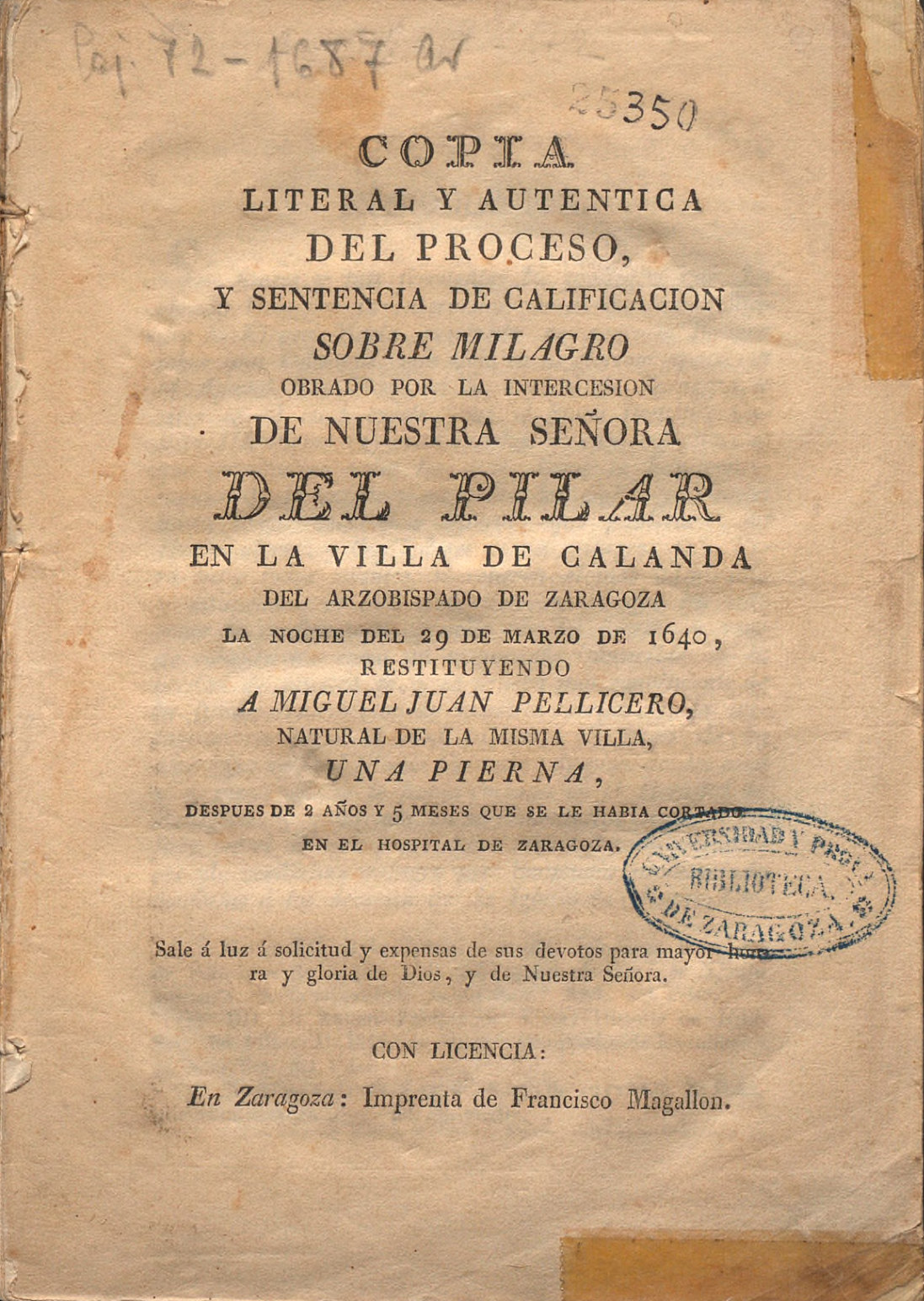
The oldest painting, an anonymous canvas of 1654 belonging to the parish of Nombrevilla, hangs in the basilica beneath Ramón Stolz's 1952 mural of the miracle. Calanda keeps 29 March as the feast of El Milagro, with the Despertadores rousing the town at dawn, Masses in the Templo del Pilar and a Rosary-procession in the evening; the Pellicer house is a museum. The original process is lost; an authenticated copy is kept in the Pilar archive and a printed edition of 1829 survives. Sceptics — most recently Gascón and Briongos (2015) — object that only copies survive, point to the Pilar chapter's rivalry with La Seo over cathedral status, and cite a 1950 exhumation at Velilla whose forensic report is said to have found the right tibia five millimetres shorter than the left, though those bones have never been shown to be Pellicer's. What no critic has produced is anyone from 1640 who denied the leg had been cut off; and the file — notarial, medical, civic, sworn within weeks by the men who did the cutting — is by any measure the strongest that survives for a claimed restoration of a limb.