
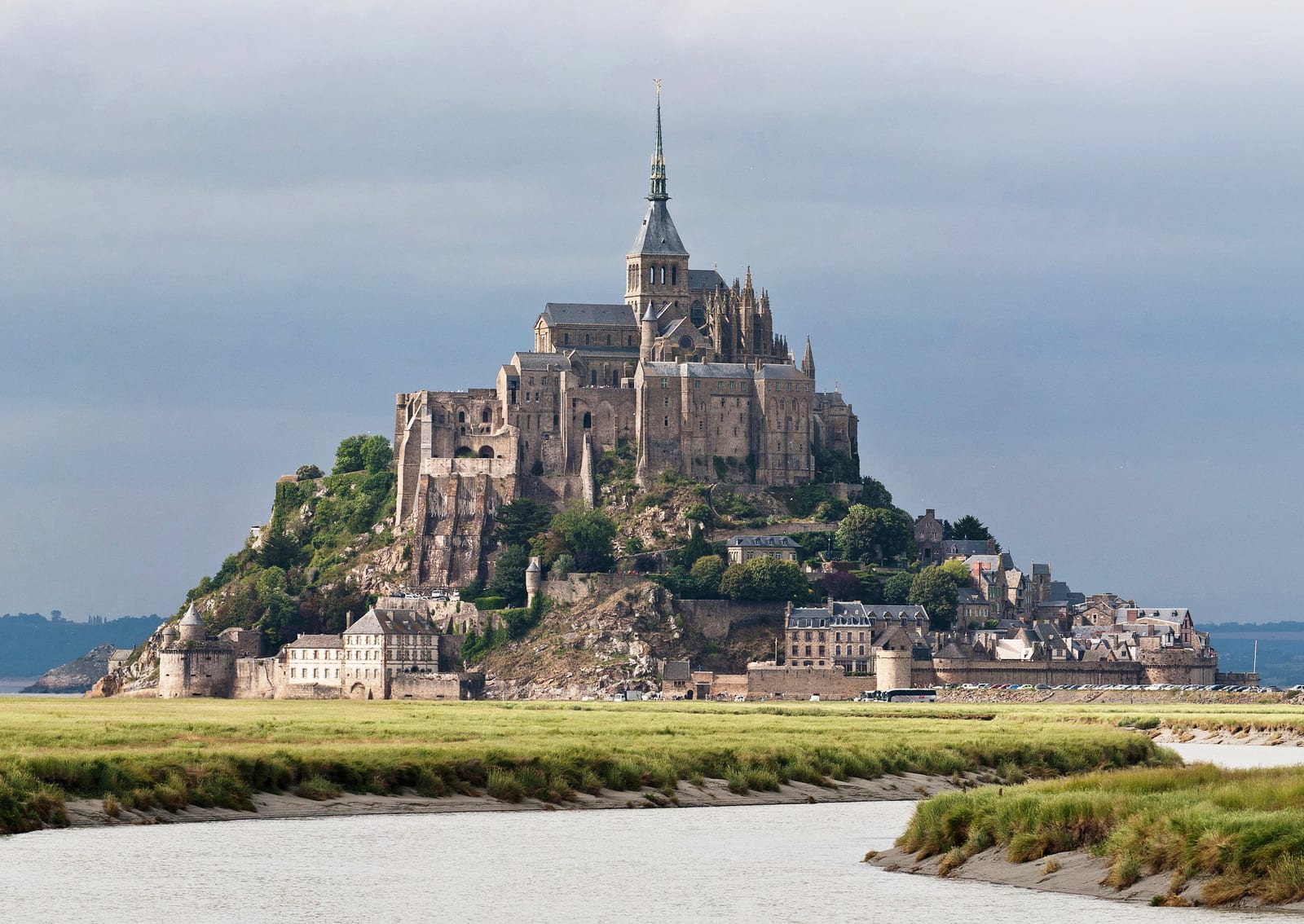
The oldest account is a Latin text called the Revelatio ecclesiae sancti Michaelis in Monte Tumba — 'the revelation of the church of St. Michael on Mont Tombe'. It opens with a long justification for building a sanctuary to the Archangel on the tidal rock between Normandy and Brittany, and then tells the story. Three times by night Michael appeared to Aubert, Bishop of Avranches, and commanded him to build on the summit a church in his honour; the bishop, fearing an illusion, delayed, and was commanded again, and again. The sanctuary was to be a round one, on the pattern of the cave of the Gargano, and the angel told him where: at the place on the summit where he would find a bull that a thief had hidden there, and within the circuit that the morning dew would leave marked on the ground.
Aubert sent two envoys to Monte Gargano, and they came back with relics of the Italian shrine: a piece of the red cloth the Archangel had laid on his altar there, and a fragment of the marble on which he had set his feet. The bishop built his church, dedicated it on 16 October, and installed twelve canons to keep the office. The year 709 is not in the Revelatio, which gives no date at all; it comes from the abbey's own tradition, fixed in the eleventh century, which set the vision in 708 and the dedication in 709. The Revelatio also knows nothing of a finger pressed into the bishop's skull. That story belongs to the eleventh century too, when the monks found what they held to be Aubert's bones and read a hole in the skull as the mark of the angel's impatience. The skull is kept at the basilica of Saint-Gervais in Avranches; a study made public in 2020 carbon-dated it to between 660 and 770 and found the hole to be the trace of a benign cyst.
The abbey's later history can be told in two sentences. In 966 Duke Richard I of Normandy replaced the canons with Benedictine monks, who raised the Romanesque abbey church from 1023 and, in the thirteenth century, the three-storeyed Gothic Merveille on the north face of the rock, and who held the Mount against the English through a siege of 1423–1434 that made it a symbol of the kingdom. The Revolution closed the abbey in 1791 and turned it into a prison that lasted until 1863; it was declared a historic monument in 1874, inscribed with its bay on UNESCO's first World Heritage List in 1979, and since 2001 has been home to the Fraternités monastiques de Jérusalem, a dozen monks and nuns living within a monument that now belongs to the French state.
On the dating: the Revelatio is not a document of 708. Pierre Bouet, who with Olivier Desbordes edited it from some thirty manuscripts, dates it to the early ninth century, around 816–820, and attributes it to a canon of the Mount writing in the aftermath of Louis the Pious's reform of the canons; others put it a little later in the same century. The oldest copy at Avranches is in the municipal library's manuscript 211, written at the Mount at the end of the tenth century, where the text is divided into eight lessons for reading in choir. The bishop is real — Aubert's name stands in the lists of the see of Avranches — and the dependence of his foundation on the Gargano is the one thing in the story the historians do not doubt: the Mount was built, from the first, as a daughter of the Italian cave.