
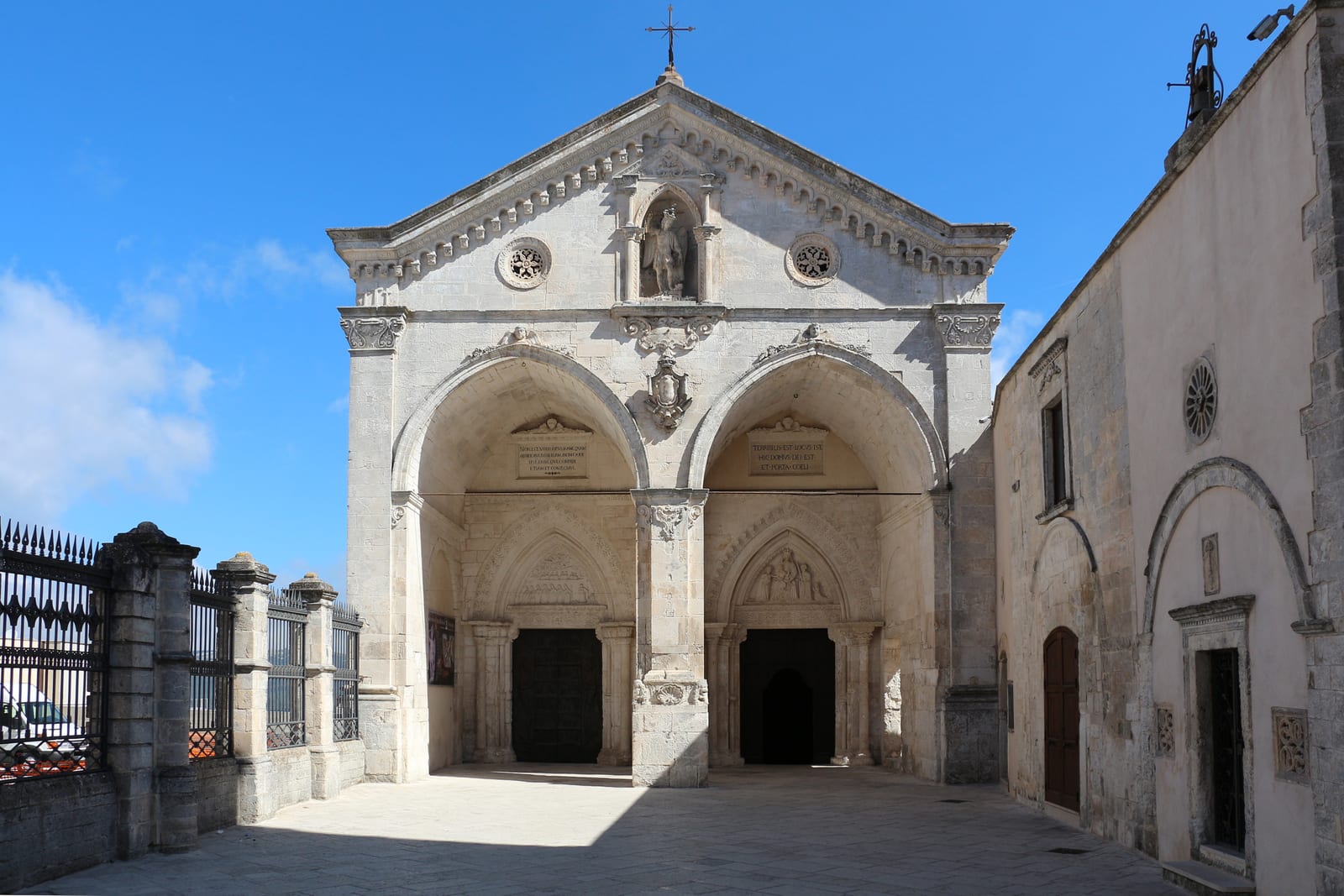
The story is told in a short Latin text, the Liber de apparitione Sancti Michaelis in Monte Gargano. A rich man of Siponto named Garganus — the mountain is said to take its name from him — had a bull that kept apart from the herd and one evening did not come home. He found it at the mouth of a cave high on the promontory and, in his anger, shot at it; the arrow turned in the air and struck the archer. The bishop ordered a fast of three days, and on the third the Archangel appeared to him: 'I am Michael the Archangel, who stand always in the presence of the Lord.' The cave was his, and under his guard; the bishop was to make it a place of Christian worship. The sanctuary dates this to 490 and names the bishop as St. Lawrence Maioranus; the Liber leaves him unnamed.
The second apparition is a battle. Siponto and Benevento were threatened by the Neapolitans, 'still pagan'; the bishop asked three days' truce for prayer, and on the night before the fight Michael told him the prayers were heard and he would be present. When the armies met, the Liber says, 'the Gargano was shaken by an immense trembling, lightning flew thick, and a dark fog covered the whole summit of the mountain'; the enemy broke, and the victors found on the rock of the cave the print of the angel's feet. The sanctuary keeps the anniversary on 8 May. Giorgio Otranto identifies the fight with Duke Grimoald's defeat of the Byzantines near Siponto in 663, recorded by Paul the Deacon — a reminder that the Liber's three scenes were not written at one time.
The third apparition settled a question the bishop had put to Rome: whether to consecrate the cave. The answer came from the Archangel. 'You have no need to dedicate this church, which I built; I myself have founded and consecrated it.' In the sanctuary's telling the bishop went up in procession with seven other bishops on 29 September and found inside the grotto an altar already standing, covered with a red cloth, near the middle of the south wall. The Liber adds the detail pilgrims still look for: from the rock beyond the altar a clear, sweet water dripped, 'which the inhabitants call the stilla', and the sick who drank it were healed. From this the shrine takes its title of the Celeste Basilica, the only church in Christendom said never to have been consecrated by human hands.
The Lombards, arriving in the seventh century, found the cult already there and made it their own: UNESCO's listing records that the sanctuary 'was founded before the arrival of the Longobards but adopted by them as a national sanctuary', and that the dukes of Benevento paid for the works that opened the cave to crowds of pilgrims, who cut their names into its corridors from the late seventh century on. The sanctuary's own register of visitors reads like a history of Europe: Leo IX three times between 1049 and 1051, Urban II in 1093, granting the same indulgences as Compostela, Celestine V in 1295; Bernard of Clairvaux, Thomas Aquinas, Bridget of Sweden; and Francis of Assisi, who in 1222 would not enter, holding himself unworthy, and carved a tau cross on a stone at the door. John Paul II came in 1987. In 2011 the sanctuary was inscribed on the World Heritage List among the seven sites of 'Longobards in Italy: Places of Power (568–774 A.D.)'.
The dating should be stated plainly. The Liber as we have it was written between the middle of the seventh century and the eighth — Otranto puts it between 663 and 750 — and its oldest manuscripts are of the late eighth or early ninth century; three stories of different ages have been joined in it. The cult is older than the book: two letters of Pope Gelasius I from 493–494, one permitting the Bishop of Larino to consecrate a basilica of St. Michael, are the earliest documents scholars connect with the Archangel's cult in the region. What the fifth-century bishop saw in the cave is beyond the historian's reach; that a church stood there under the Archangel's name by the sixth century is not. The sanctuary also counts a fourth apparition: in the plague of 1656 Archbishop Alfonso Puccinelli was told to bless stones from the grotto, marked with a cross and the letters M.A., and those who carried them were spared.