
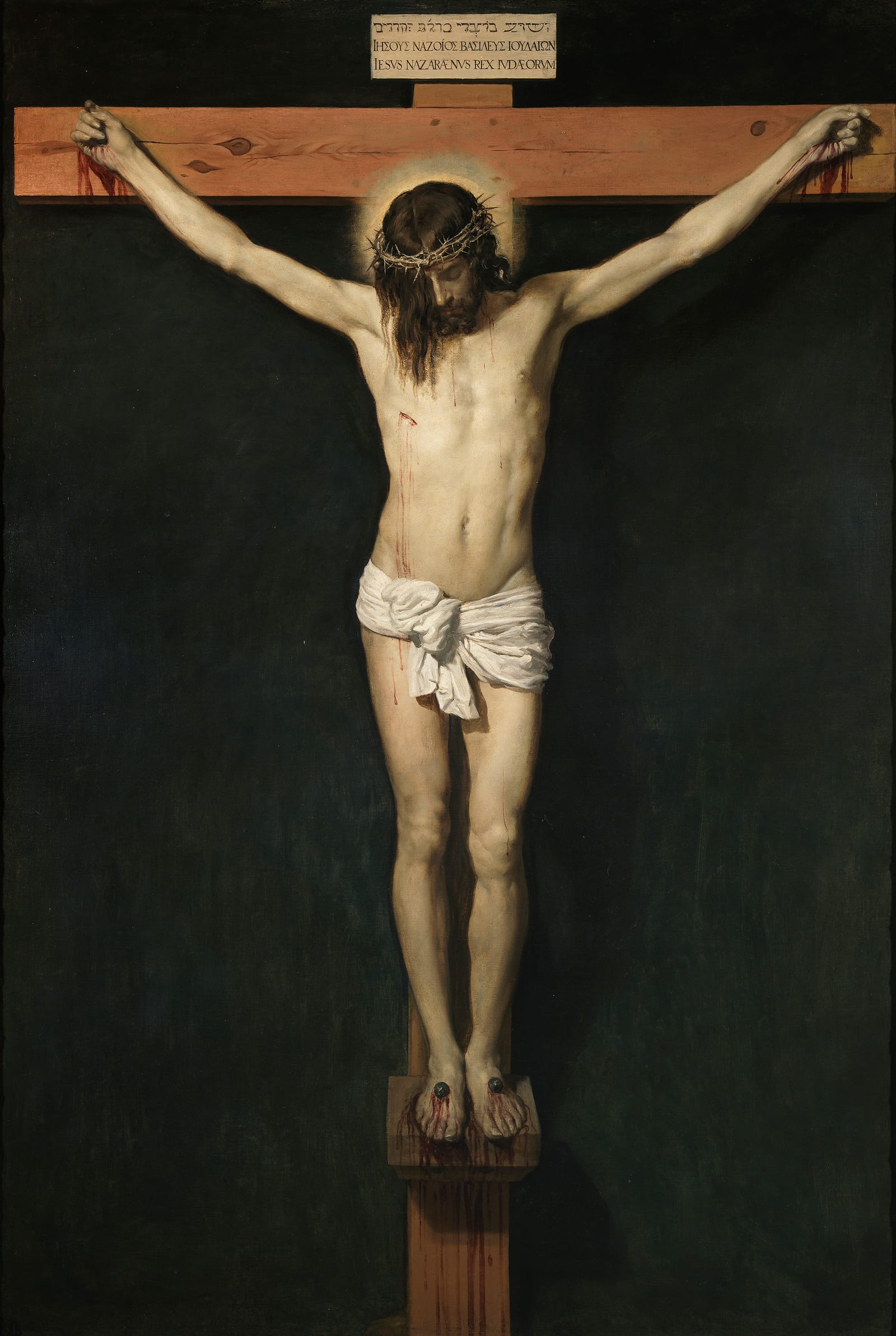
Psalm 22 (Psalm 21 in the Douay-Rheims numbering) is David's cry of the righteous sufferer, and its details outrun anything in David's own life: 'All they that saw me have LAUGHED ME TO SCORN... they have spoken with the lips, and WAGGED THE HEAD: He hoped in the Lord, LET HIM DELIVER HIM' (22:7–8)... 'they have DUG MY HANDS AND FEET. They have numbered all my bones... They PARTED MY GARMENTS amongst them; and upon my vesture they CAST LOTS' (22:16–18). Crucifixion — a Persian and Roman method — did not exist in David's Israel.
The evangelists narrate Calvary in the psalm's own words: the passers-by 'blasphemed him, wagging their heads' and the priests mocked, 'He trusted in God; let him now deliver him' (Matthew 27:39–43, quoting 22:8 apparently without realizing it); the soldiers 'dividing his garments, cast lots' — John specifies the seamless coat and cites the verse verbatim (John 19:23–24). And at the ninth hour Jesus cried out the psalm's opening line in His own tongue: 'ELI, ELI, LAMMA SABACTHANI?' (Matthew 27:46).
To pray a psalm's first line was, in Jewish practice, to invoke the whole of it — and Psalm 22 does not end in abandonment. It turns: 'I will declare thy name to my brethren; in the midst of the church will I praise thee... All the ends of the earth shall remember, and shall be converted to the Lord' (22:22–27). From the Cross, the psalm's trajectory — dereliction to worldwide praise — is claimed entire.
One textual matter, shown for both sides: in verse 16 the Masoretic Hebrew reads ka'ari ('like a lion [at] my hands and feet'), while the Septuagint — translated by Jewish scholars long before Christ — and the oldest Hebrew witness of the verse (a scroll from Nahal Hever) read the verb 'they dug/pierced.' The Douay-Rheims follows the ancient reading: 'they have dug my hands and feet.'