
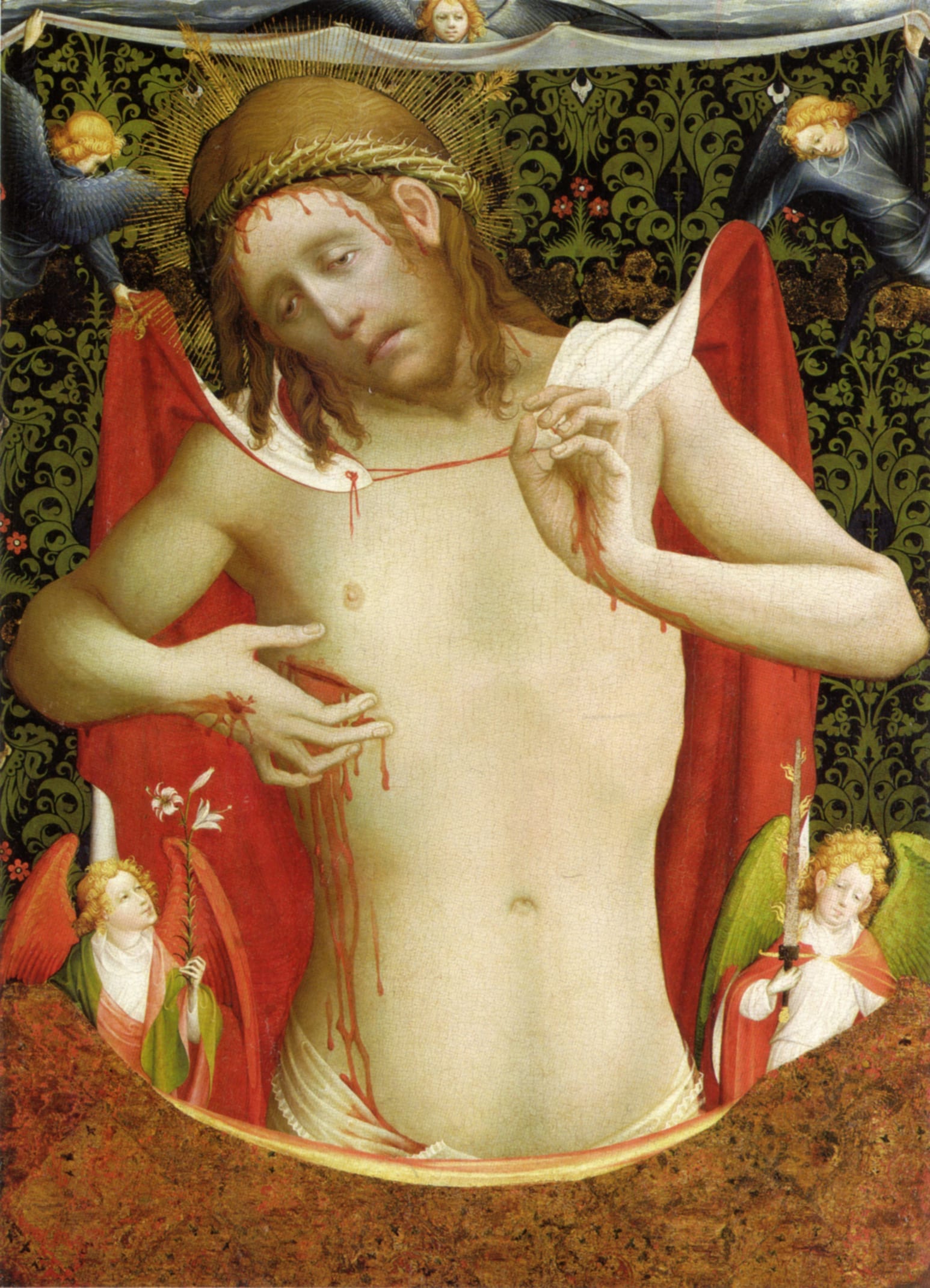
Isaiah 52:13–53:12, the fourth Song of the Servant, reads like a Passion narrative in the future tense: 'Despised, and the most abject of men, a man of sorrows... Surely he hath borne our infirmities and carried our sorrows... he was WOUNDED FOR OUR INIQUITIES, he was bruised for our sins: the chastisement of our peace was upon him, and by his bruises we are healed... He shall be led as a SHEEP TO THE SLAUGHTER, and shall be dumb as a lamb before his shearer, and he shall not open his mouth... He was reputed with the wicked: and he hath borne the sins of many, and hath prayed for the transgressors' (Isaiah 53:3–12).
The correspondences the Gospels record are point-for-point: His silence before Caiaphas, Herod, and Pilate ('he answered him to never a word,' Matthew 27:14); crucified between two robbers — 'numbered with the wicked'; praying for His executioners — 'making intercession for the transgressors'; the guiltless one 'who did no iniquity, neither was deceit in his mouth' (53:9; 1 Peter 2:22). This is the chapter the Ethiopian eunuch was reading in his chariot when Philip 'preached unto him Jesus' from that very scripture (Acts 8:32–35) — the catalogue's own entry on that meeting tells the story.
No text did more to form the Church's understanding of the Cross: Christ Himself invoked it on the way to Gethsemane ('this that is written must yet be fulfilled in me: And with the wicked was he reckoned,' Luke 22:37), and the earliest preaching simply pointed at it. The complete Isaiah scroll found at Qumran, copied a century or more before Christ, removes any question of the text being written after the fact.
Honest scholarship is noted per the source policy: Jewish interpretation has often read the Servant corporately, as Israel personified in her sufferings — a reading with real footholds in Isaiah's earlier songs. The Christian answer has always been the chapter's own logic: this Servant suffers not with the people but FOR them — 'for the wickedness of MY PEOPLE have I struck him' — innocent, silent, and vindicated after death; a description that fits no nation, and one Man exactly.