
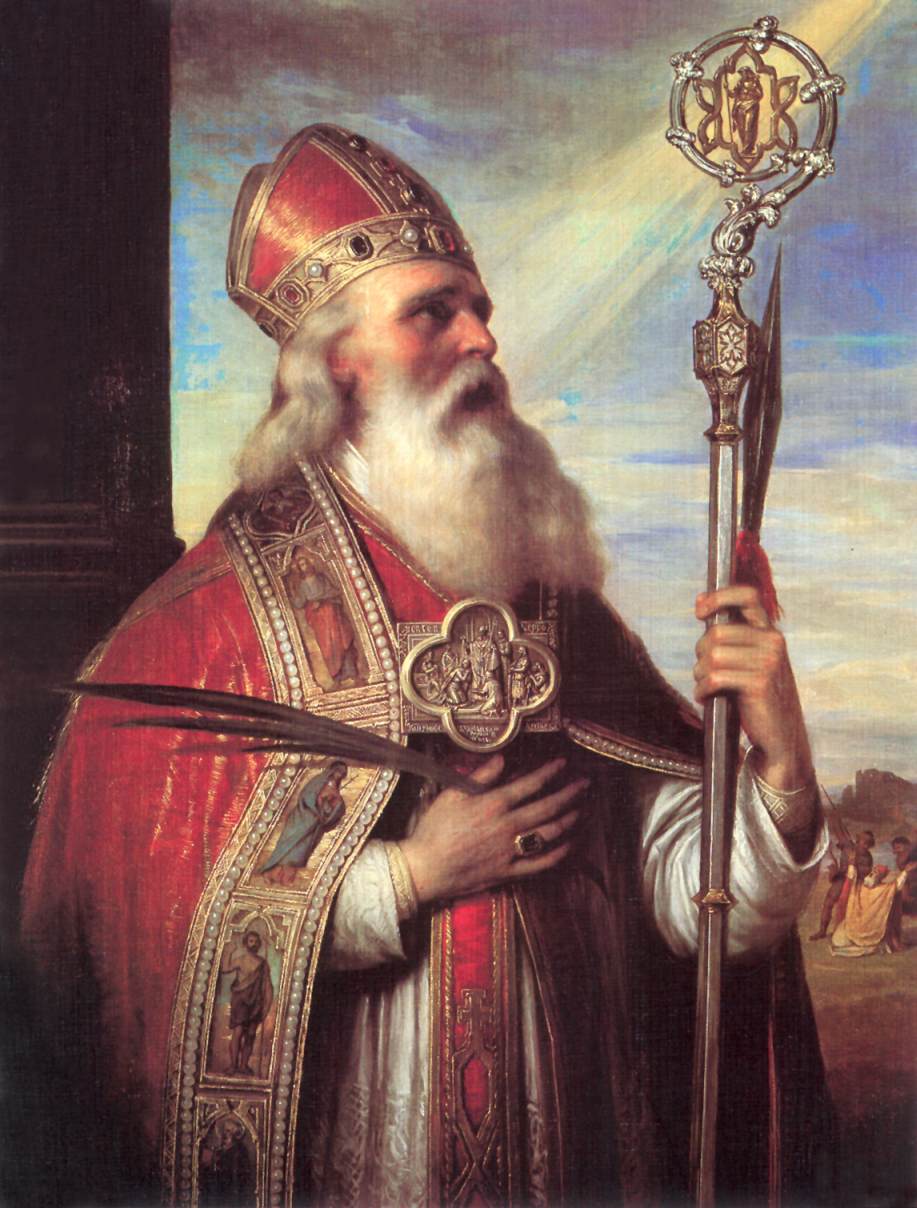
Adalbert was born Vojtěch — second son of the Slavník Prince Slavnik of Libice in northeastern Bohemia. Educated at Magdeburg under Archbishop Adalbert (whose name he took in confirmation), he returned to Bohemia in 982 and was elected the second Bishop of Prague at twenty-seven.
His attempts to enforce stricter Christian practice on the still-half-pagan Bohemian aristocracy met fierce resistance. Repeatedly driven from Prague — once by the murder of the entire Slavník family on the Přemyslid orders — he found refuge as a monk at the Roman monastery of Sts. Boniface and Alexis on the Aventine.
Pope Gregory V eventually sent him north as a missionary bishop. After failed missions to the Hungarians and the unsuccessful conversion of the Old Prussians (Baltic pagans), he was killed by Prussian priests at Truso on April 23, 997 — by tradition speared seven times after celebrating Mass on the seashore.
His friend King Boleslav I the Brave of Poland ransomed his body for its weight in gold from the pagans and enshrined it at Gniezno — making the body of Adalbert the founding relic of the Polish Church. The famous gold doors of Gniezno Cathedral (12th c.) depict eighteen scenes from his life and martyrdom — the masterpiece of medieval Polish art.