
MIRACULOUS MIRACLES™

Saint — Adelaide of Italy

St. Adelaide of Italy
c. 931 AD, Orbe, Burgundy (royal Burgundian palace) — December 16, 999 AD, Seltz Abbey, Alsace (her foundation)
Holy Roman Empress (962–973); Ottonian queen-mother and queen-regent
Seltz Abbey, Alsace, France (modern Bas-Rhin, France) — her personal foundation of 991; medieval shrine destroyed in the Reformation and Revolution; cult continues in Alsatian Catholic tradition, France
Feast
December 16
Canonized
Canonized 1097 by Pope Urban II
Life

Adelaide was born around 931 to King Rudolf II of Burgundy and his queen Bertha of Swabia. At age 6, on the death of her father in 937, she was betrothed (and at age 16, in 947, married) to Lothair II of Italy — the son of Hugh of Provence and king of Italy.

Lothair II died (probably poisoned) in November 950; his successor Berengar II of Ivrea usurped the Italian throne and attempted to compel Adelaide to marry his son Adalbert. Refusing, she was imprisoned in 951 by Berengar in the fortress of Garda — but miraculously escaped (per tradition, by digging through the castle floor with the help of her chaplain).

From hiding she appealed to the German king Otto I — who invaded Italy, defeated Berengar, and married Adelaide himself in 951 at Pavia. The marriage united the German and Italian royal traditions; on Christmas Day 962, the couple were crowned by Pope John XII as Holy Roman Emperor and Empress — the beginning of the thousand-year Holy Roman Empire that would continue until 1806.

Adelaide and Otto I produced four children: Henry, Bruno (both died in infancy), Mathilda (abbess of Quedlinburg), and Otto II (future emperor, 973–983).

On Otto I's death in 973, Otto II succeeded as emperor (with his Byzantine-princess wife Theophanu); Adelaide clashed with her daughter-in-law and was exiled from court. On Otto II's sudden death in 983 (at the age of 28), Adelaide returned as co-regent (with Theophanu) for her three-year-old grandson Otto III. On Theophanu's death in 991, Adelaide ruled as sole regent until Otto III's majority in 994 — making her the uniquely the empress-regent for three generations (queen-consort of Otto I, queen-mother of Otto II, queen-regent for Otto III).

In 991 she founded the monastery of Seltz in Alsace as her personal retreat; she died there on December 16, 999, having lived through and shaped the Ottonian Catholic-imperial settlement of central and southern Europe. Pope Urban II canonized her in 1097.

Miracles & Phenomena
  • The miraculous escape from the fortress of Garda (951)

    Adelaide's miraculous escape from imprisonment in the fortress of Garda by Berengar II of Ivrea — digging through the castle floor with the help of her chaplain — and her appeal to King Otto I of Germany, which produced the Otto-Adelaide marriage and the Christmas 962 imperial coronation, is the dramatic political-miraculous episode of the early Ottonian Empire. The consequence — the creation of the Holy Roman Empire — shaped the thousand years of European political-ecclesiastical history.

  • The three-generation queen-regent tradition

    Adelaide's unique role as queen-consort of Otto I (962–973), queen-mother of Otto II (973–983), and queen-regent for her grandson Otto III (983–994) — three generations of queen-imperial influence over the Ottonian Empire — is unparalleled in early-medieval European political history. The Adelaide model shaped the Catholic queen-mother-regent tradition that would extend through the Capetian, Plantagenet, and Habsburg dynasties to the modern Catholic monarchies.

Relics
  • Body
    Tomb of St. Adelaide
    Seltz Abbey, Alsace, France — her foundation of 991; the medieval shrine destroyed in the 16th-century Reformation and the 18th-century French Revolutionary dissolution; fragmentary relics survive at the Catholic Cathedral of Strasbourg and at the Hofburg in Vienna

    Her medieval shrine at Seltz Abbey was destroyed in the Reformation and Revolution; fragmentary relics survive at the Catholic Cathedral of Strasbourg (Notre-Dame de Strasbourg) and at the Hofburg Imperial Treasury in Vienna.

Iconography
  • Adelaide crowned at St. Peter's Christmas 962

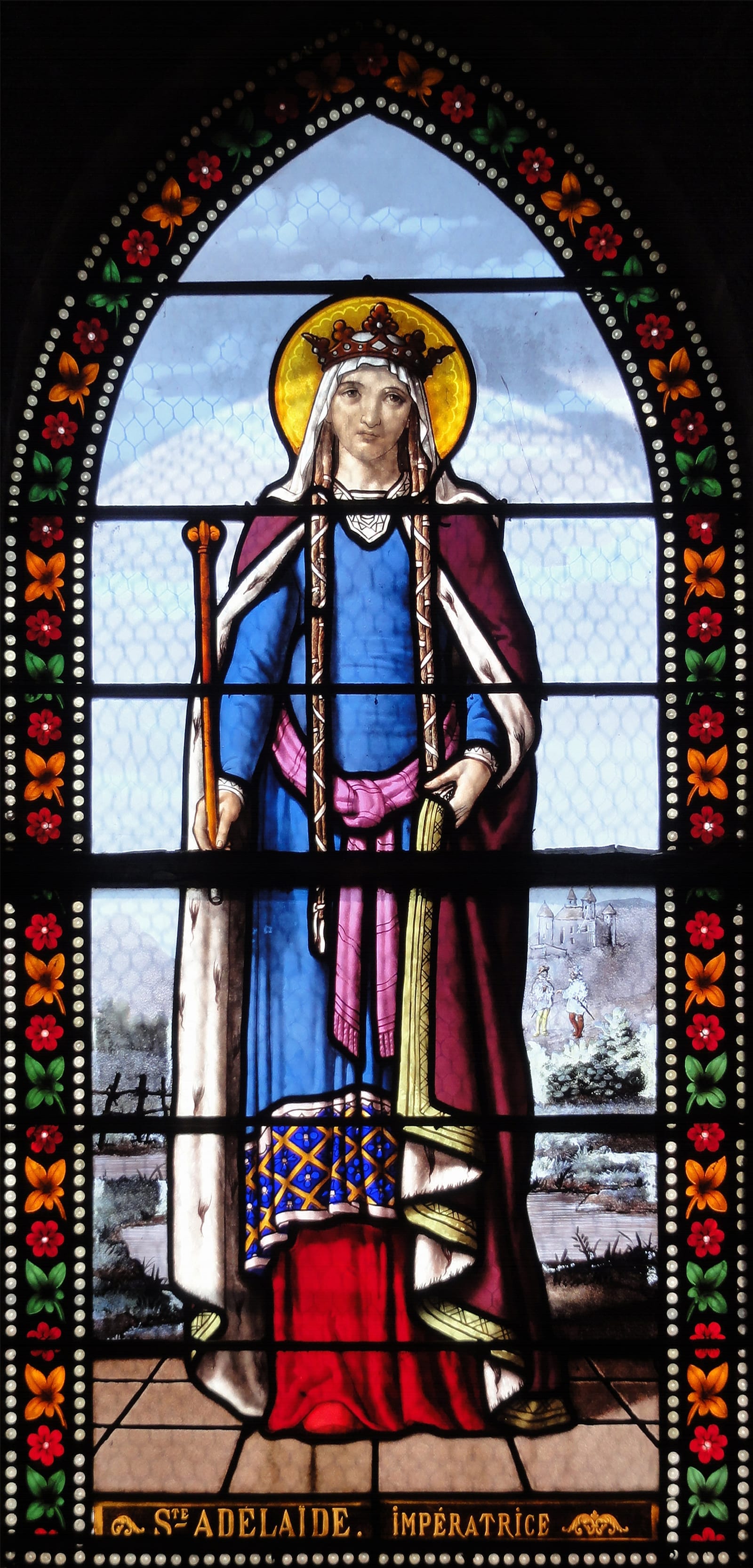
    The mid-10th-century Holy Roman Empress in Ottonian imperial regalia at the basilica of St. Peter's in Rome on Christmas Day 962 receiving the imperial crown from Pope John XII, her husband Emperor Otto I beside her, the Carolingian-imperial succession renewed in the Saxon-Ottonian dynasty — the iconography of Catholic Ottonian-imperial coronation tradition.

Patronages
Catholic empresses and queen-regentsThe Alsatian Catholic tradition (Seltz)Catholic in-laws (the pattern of her role as mother-in-law of three royal generations)Catholic widows of royal families (twice widowed)Catholic prisoners of conscience (her imprisonment by Berengar of Ivrea, 951)