
MIRACULOUS MIRACLES™

Saint — Sts. Adrian and Natalia

Sts. Adrian and Natalia
Late 3rd century, Nicomedia — c. 306 AD, Nicomedia (Adrian); c. 311 AD, Constantinople or Argyropolis (Natalia)
Pagan Praetorian Become Martyr — His Christian Wife Who Recovered His Hand
Catholic shrines at Nicomedia (modern İzmit, Turkey); major Western shrine at the Abbey of Sint-Adriaansabdij at Geraardsbergen, Belgium (relics translated there 1110), Belgium
Feast
September 8 (Latin); August 26 (Byzantine)
Canonized
Cult of ancient antiquity
✠ MartyrAdrian's hands and feet severed before beheading at Nicomedia, March 4, 306 (Natalia died in peace c. 311) → The Martyrs
Life

Adrian (Latin Hadrianus) was a young Roman officer of the praetorian guard at Nicomedia (the eastern imperial capital from which Diocletian launched the Great Persecution) in the year 306 AD. He was a pagan. His wife Natalia was a secret Christian.

Per the foundational Greek Acts of Sts. Adrian and Natalia, Adrian was the registrar (notarius) of the trials of Christians at Nicomedia. After registering the details of one extended interrogation in which a group of 23 Christian witnesses had endured prolonged tortures without yielding, Adrian himself was so moved that he asked the prisoners: 'What reward do you expect from your God for such sufferings?' They answered him: 'Eye has not seen, nor ear heard...what God has prepared for those who love him' (1 Corinthians 2:9). Adrian — at the conclusion of the interrogation, before the assembled tribunal — declared himself a Christian and asked to be added to the list of the condemned. He was immediately imprisoned.

When Natalia learned of her husband's confession, she rushed to the prison overjoyed (according to the Acts, she had been praying for years for Adrian's conversion). She supported him through the period of imprisonment. At his execution — on March 4, 306 — Adrian's hands and feet were severed before he was beheaded. After the executioners had burnt the bodies of all the Christian victims in a great pyre and a sudden storm extinguished the pyre, Natalia gathered the principal relics of her husband, including in particular his severed right hand (which she preserved in her own home as a personal relic). She fled with the relics to Argyropolis near Byzantium, where she lived as a widow until her own death around 311. The cult of Adrian and Natalia together was particularly intense in the early medieval period; the great Flemish abbey of Sint-Adriaansabdij at Geraardsbergen received the main body relics in 1110 and was for the rest of the medieval period the principal Flemish-Catholic pilgrimage shrine north of the Pyrenees outside Compostela.

Miracles & Phenomena
  • Natalia recovering Adrian's hand

    Natalia's recovery of her husband's severed right hand from the pyre at Nicomedia — and her preservation of the relic in her own home through the remainder of her life — became the foundational iconographic emblem of the cult of Christian widows and of the marital co-witness tradition.

Relics
  • Body
    Bodies of Sts. Adrian and Natalia
    Sint-Adriaansabdij Abbey, Geraardsbergen, East Flanders, Belgium (translated 1110); also at the Roman church of Santa Maria in Cosmedin

    The main relics of Adrian were translated from Nicomedia to Rome in the 5th century, then to Geraardsbergen in Flanders in 1110. Geraardsbergen became one of the principal medieval Catholic pilgrimage destinations of northern Europe.

Iconography
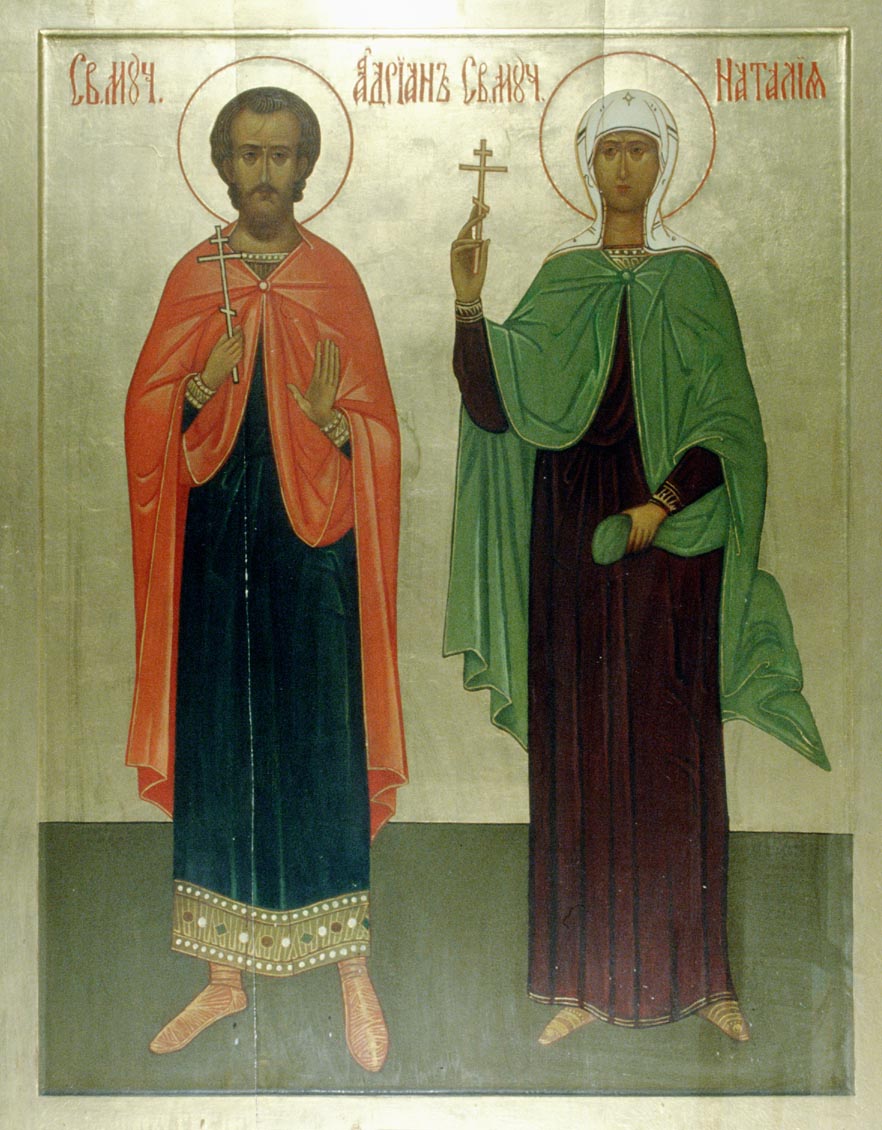
  • Adrian and Natalia with the severed hand

    The young Roman praetorian in late-3rd-century armour with his right hand visibly severed, his Christian wife Natalia in widow's veil holding the small reliquary-box of the recovered hand — the iconography of the foundational Christian marital co-witness tradition.

Patronages
Catholic soldiersCatholic prison guardsButchersSmiths and blacksmithsArms-dealers and arms-makers (an early-medieval Flemish guild patronage)Diocese of GeraardsbergenFaithful Christian widowsCatholic married couples in joint witnessPlague (Belgian medieval invocation)