
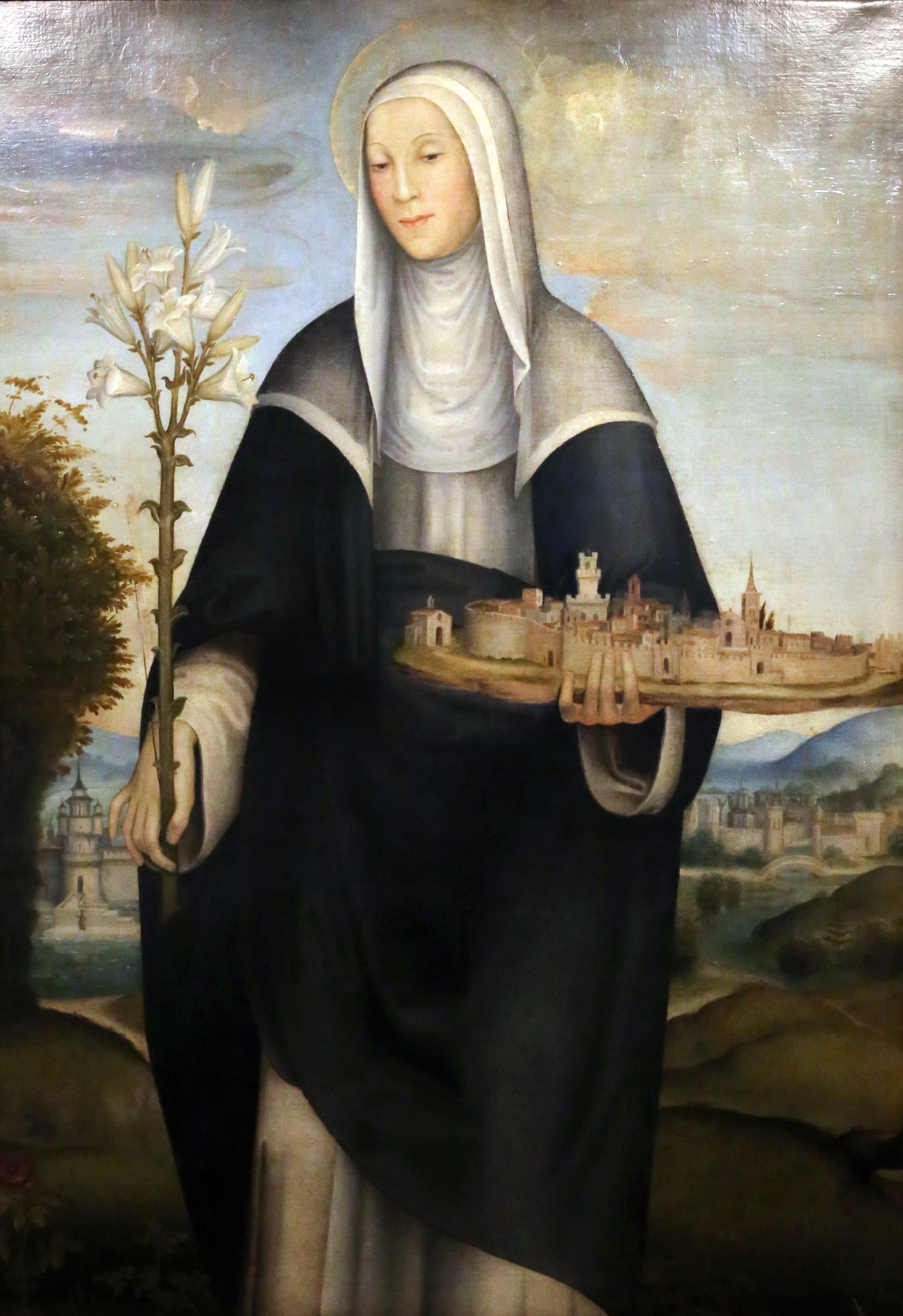
Agnes was born in 1268 in Gracciano-Vecchio near Montepulciano to the noble Tuscan Segni family. From early childhood she displayed the Catholic-vocation-signs of young mystics — aversion to worldly amusement, prayer, and piety.
At the age of 9 (1277), Agnes entered the Franciscan-affiliated 'Sacchine' (Sackcloth Sisters) convent at Montepulciano as a child oblate. At the age of 14 (1282), she was sent to found a new convent at Proceno near Orvieto, becoming abbess at the extraordinary young age.
Around 1306, Agnes returned to Montepulciano and founded the Dominican Monastery of Sant'Agnese — converting from the previous Franciscan-Sackcloth affiliation to the Dominican Order. She served as prioress of the Sant'Agnese Monastery until her death in 1317.
Agnes became famous during her lifetime for her mystical-ecstatic experiences: visions of the Christ-Child (the famous 'Agnes-Christ-Child' mystical devotion), visions of the Blessed Virgin, levitations during prayer, and bilocations.
Her most famous mystical episode: during a vision of the Christ-Child, the Child placed a small crucifix into Agnes's hands — the crucifix remaining in her physical possession as a tangible miraculous relic. The Agnes-crucifix survives in continuous Catholic veneration at the Basilica of Sant'Agnese at Montepulciano.
She died at Montepulciano on April 20, 1317, at the age of 49. Her incorrupt body — preserved to the present day at the Basilica of Sant'Agnese — continued to exude a miraculous fragrance (odour of sanctity) for the centuries.
Half a century after her death, St. Catherine of Siena (1347–1380) undertook the personal pilgrimage to the tomb of Agnes at Montepulciano — documenting the miraculous phenomenon (per Catherine's biographer Bl. Raymond of Capua) that when Catherine kissed Agnes's incorrupt foot in veneration, the foot miraculously raised itself to meet Catherine's kiss. The Catherine-Agnes veneration established the Tuscan-Dominican saint-to-saint devotional tradition.