
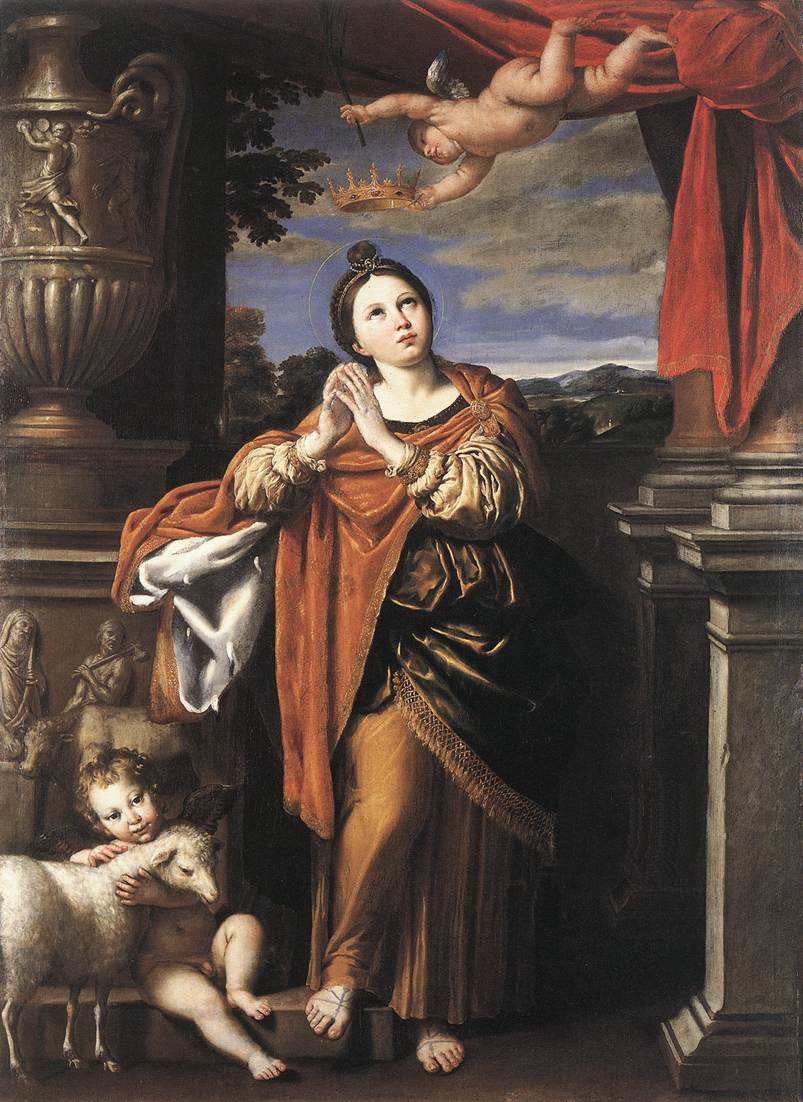
Agnes was thirteen years old, the daughter of a noble Roman family, when she was denounced as a Christian during the Diocletianic persecution. The accounts of her martyrdom — by Sts. Ambrose, Damasus, and Prudentius, all writing within a century — are unusually rich.
Refusing to marry the son of the prefect, she was stripped and led to a brothel; her hair grew miraculously to cover her. A suitor who attempted to violate her was struck blind on touching her; she healed him at his repentance. Condemned at last to be burned, the flames refused to burn her. She was killed by a single sword-stroke at the throat. She was thirteen.
Her name (Greek hagne, 'pure'; Latin agnus, 'lamb') gave rise to the iconography of Agnes with a lamb. Each year on January 21 in her basilica two lambs are blessed; their wool is woven into the palliums conferred by the pope on metropolitan archbishops — a thread of continuity from her martyrdom to the present-day Church.