
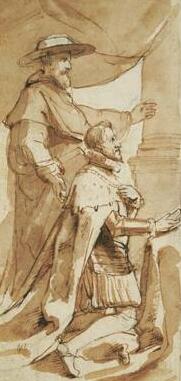
Albert was born in 1166 to Duke Godfrey III of Brabant and his wife Margaret of Limburg — the younger son of the principal Brabantine royal house and brother of the future Henry I, Duke of Brabant.
Educated as a young cleric at the cathedral of Cambrai, he became a canon of the cathedral of Liège (the principal Lotharingian episcopal see, one of the principal prince-bishoprics of the Holy Roman Empire) at the age of 12. He rose to be archdeacon of Liège.
On the death of Prince-Bishop Raoul of Zähringen in 1191, the cathedral chapter of Liège elected the 25-year-old Albert as Prince-Bishop of Liège — a politically controversial election in the context of the continuing Investiture Controversy and the tensions between the Brabantine duchy and the German imperial authority.
Holy Roman Emperor Henry VI (1190–1197, the son of Frederick Barbarossa) refused to confirm Albert's election — citing the canonical irregularities of the election and advancing the rival candidate Lothair of Hochstaden. The dispute was referred to Rome for papal decision.
Pope Celestine III in early 1192 confirmed Albert's election. Albert travelled to Reims in autumn 1192 for his episcopal consecration — on the invitation of the French royal court, the politically-protective alternative to the hostile imperial territory.
He was consecrated Bishop of Liège on September 19, 1192 by Archbishop William of the Hands of Whitehands of Reims (the uncle of King Philip II Augustus of France). Two months later, on November 24, 1192, three knights of Emperor Henry VI followed Albert to Reims and assassinated him on the road outside the city, cutting him down with swords.
The assassination of Albert at Reims — just 22 years after the analogous assassination of St. Thomas Becket at Canterbury Cathedral (December 29, 1170) — produced the immediate scandal and political-ecclesiastical outrage of the late-12th-century Catholic Latin West. The martyr-bishop was immediately venerated as a saint by the Lotharingian-Brabantine Catholic faithful; his long-pending canonization was finally completed by Pope Paul V in 1613.
His principal relics were translated from Reims to the Cathedral of Saint-Lambert in Liège in 1612 (just before the formal papal canonization).