
MIRACULOUS MIRACLES™

Saint — Albert the Great (Albertus Magnus)

St. Albert the Great (Albertus Magnus)
c. 1200, Lauingen, Swabia — November 15, 1280, Cologne
Doctor Universalis — the Universal Doctor
St. Andrew's Church (St. Andreas), Cologne, Germany
Feast
November 15
Canonized
Canonized and declared Doctor of the Church the same day: December 16, 1931 (by Pius XI)
Doctor of the Church
Yes
Life

Albert was born to the Counts of Bollstädt in Bavarian Swabia. He studied at the University of Padua, where he encountered the new Aristotelian science arriving via Arabic translation, and around 1223 joined the new Dominican Order. He was sent to teach at Cologne, Hildesheim, Freiburg, Regensburg, Strasbourg — and at Paris, where Thomas Aquinas was his student.

He was the first medieval Christian thinker to comment systematically on the entire surviving Aristotelian corpus — physics, metaphysics, biology, ethics, politics — making Aristotle's natural philosophy available to Latin Christianity in a way that prepared the ground for Aquinas's theological synthesis. He was equally a natural scientist in his own right: his treatises on plants, on animals, on minerals, on alchemy, on astronomy, on meteorology contain firsthand observations that are still cited in the history of science.

Made Bishop of Regensburg in 1260 against his will, he resigned after two years to return to teaching. In 1277, when the Bishop of Paris condemned a number of propositions taken (in part) from Aquinas, the seventy-seven-year-old Albert travelled to Paris in person to defend his late student — saying that anyone who slandered Thomas slandered the truth itself.

He was canonised and declared a Doctor of the Church on the same day by Pius XI in 1931. Pius XII made him patron of natural scientists in 1941. His body, found incorrupt at his first exhumation, was found reduced to a skeleton at a second; the bones rest in a Roman sarcophagus in the crypt of St. Andrew's Church in Cologne.

Miracles & Phenomena
  • Aristotelian Commentaries

    Twenty-one volumes of paraphrased commentary on Aristotle — the first systematic Christian engagement with the whole of pagan natural philosophy, making possible the High Scholastic synthesis.

  • Defense of Aquinas at Paris (1277)

    After the death of his pupil Thomas Aquinas and the condemnations issued by Bishop Tempier of Paris in 1277, the aged Albert travelled to Paris to defend Thomas's teaching in person — one of the great acts of loyalty in the history of Western thought.

Relics
  • Body
    Tomb of St. Albert the Great
    Crypt of St. Andrew's Church (St. Andreas), Cologne

    His remains rest in a Roman porphyry sarcophagus beneath the floor of the Dominican-run church of St. Andreas — the church where he taught, prayed, and died.

Iconography
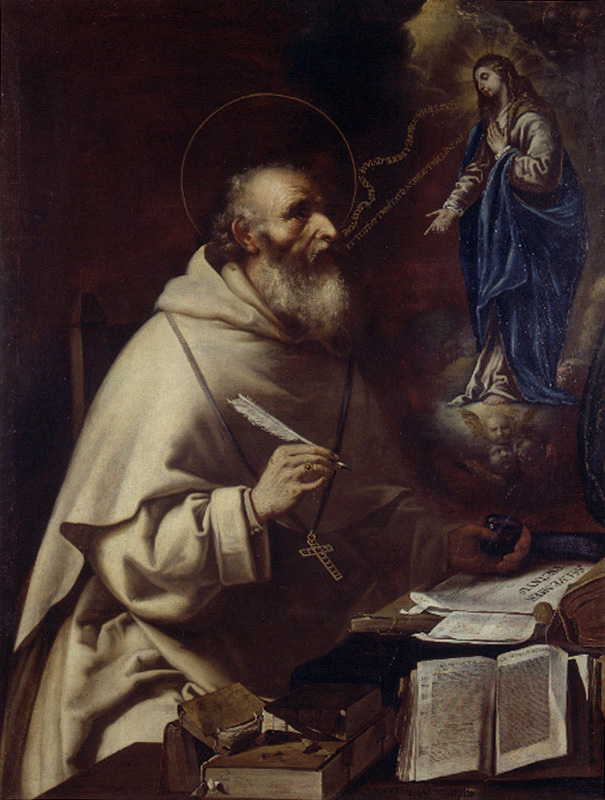
  • Albert with the Book, the Quill, and the Astrolabe

    Often depicted as a Dominican in episcopal vesture, holding a book and a quill, with an astrolabe or scientific instrument at his side — sometimes with the young Thomas Aquinas at his feet.

Patronages
Natural scientists (declared by Pius XII in 1941)PhilosophersMedical techniciansStudentsSchoolchildren
Sources & Further Reading