
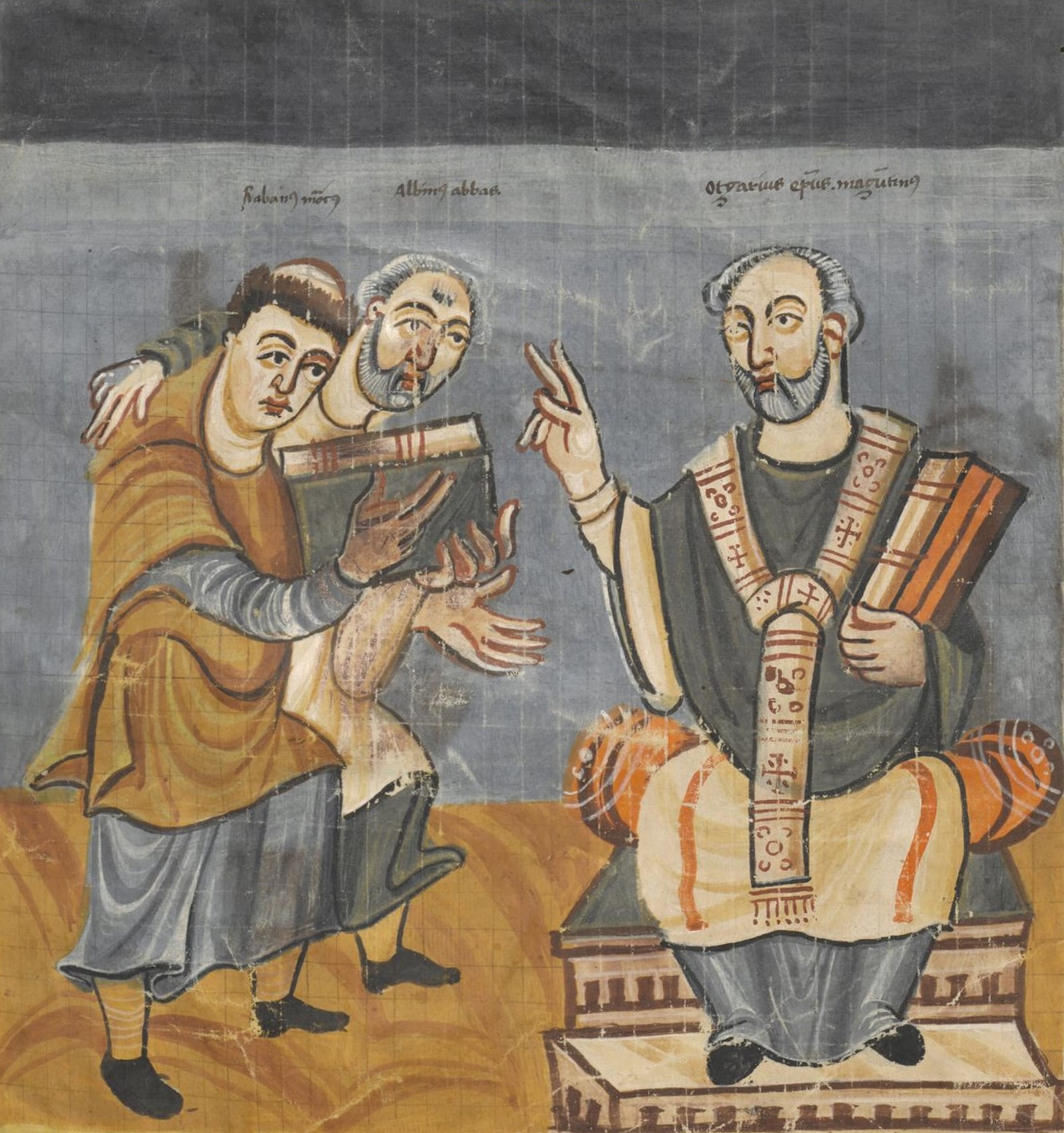
Alcuin was educated at the cathedral school of York under Archbishop Egbert — pupil of Bede and inheritor of the great Northumbrian library — eventually becoming its master in 778. In 781, returning from a journey to Rome, he met King Charles in Parma; the king persuaded him to come to the Frankish court as master of the palace school.
He spent the next twenty-three years (782–804) as head of Charlemagne's palace school and chief intellectual architect of the Carolingian Renaissance. He reformed clerical education, established the model curriculum of the seven liberal arts, organized the standardization of Latin (the 'Carolingian minuscule' script that became the basis of every Western printed font), and supervised the production of corrected biblical and liturgical texts — including the great Alcuin Bible that became the standard Latin Bible of the early Middle Ages.
He composed the Latin Mass for All Saints, the rite of Confession used through the Middle Ages, and many of the prayers of the medieval Latin missal. His Letters and his Latin poems — 'When in the green meadows the cattle return at evening / Then to the school where the wise teacher waits' — show a humanism unique in his time.
In 796 Charlemagne gave him the great Abbey of Saint-Martin at Tours, where he retired with his closest pupils to spend his last eight years. He died there on Pentecost Sunday, May 19, 804.