
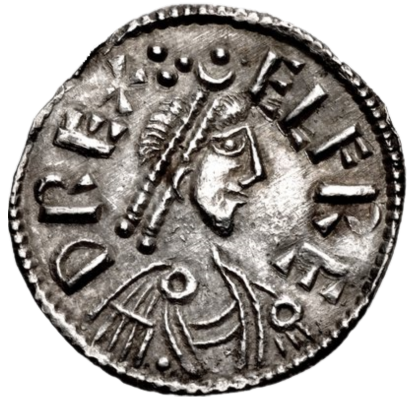
Alfred was the youngest of five sons of King Ethelwulf of Wessex. As a small boy he had been sent twice to Rome and confirmed by Pope Leo IV. He inherited the throne in 871 at twenty-one, at the lowest point of the Viking invasions — the Great Heathen Army had already devastated the other three English kingdoms.
After being driven into the Somerset marshes in early 878 (where, by the famous story, he burned the cakes a peasant woman had asked him to watch), he gathered the surviving fyrd of Wessex and won a decisive victory at the Battle of Edington in May 878. The Treaty of Wedmore that followed required the Viking leader Guthrum to be baptized — Alfred standing godfather to him at Aller in Somerset — and to withdraw to the Danelaw.
Alfred then devoted twenty years to the Christian re-foundation of Wessex. He founded a court school on the Carolingian model, personally learning Latin and translating Boethius, Augustine, Gregory the Great, and the Psalms into Old English. He established the first English navy. He compiled the laws of Wessex into a single code that explicitly recognized the Ten Commandments as the foundation of English law. He paid two-thirds of his revenue to the Church to rebuild monasteries the Vikings had destroyed.
Asser of Sherborne, the Welsh monk Alfred summoned to his court, wrote a contemporary Life of Alfred (893) that is the principal source for his life. Although never formally canonized by Rome, he is venerated in the Anglican calendar and is the only English monarch given the epithet 'the Great.' He died at Winchester at fifty on October 26, 899.