
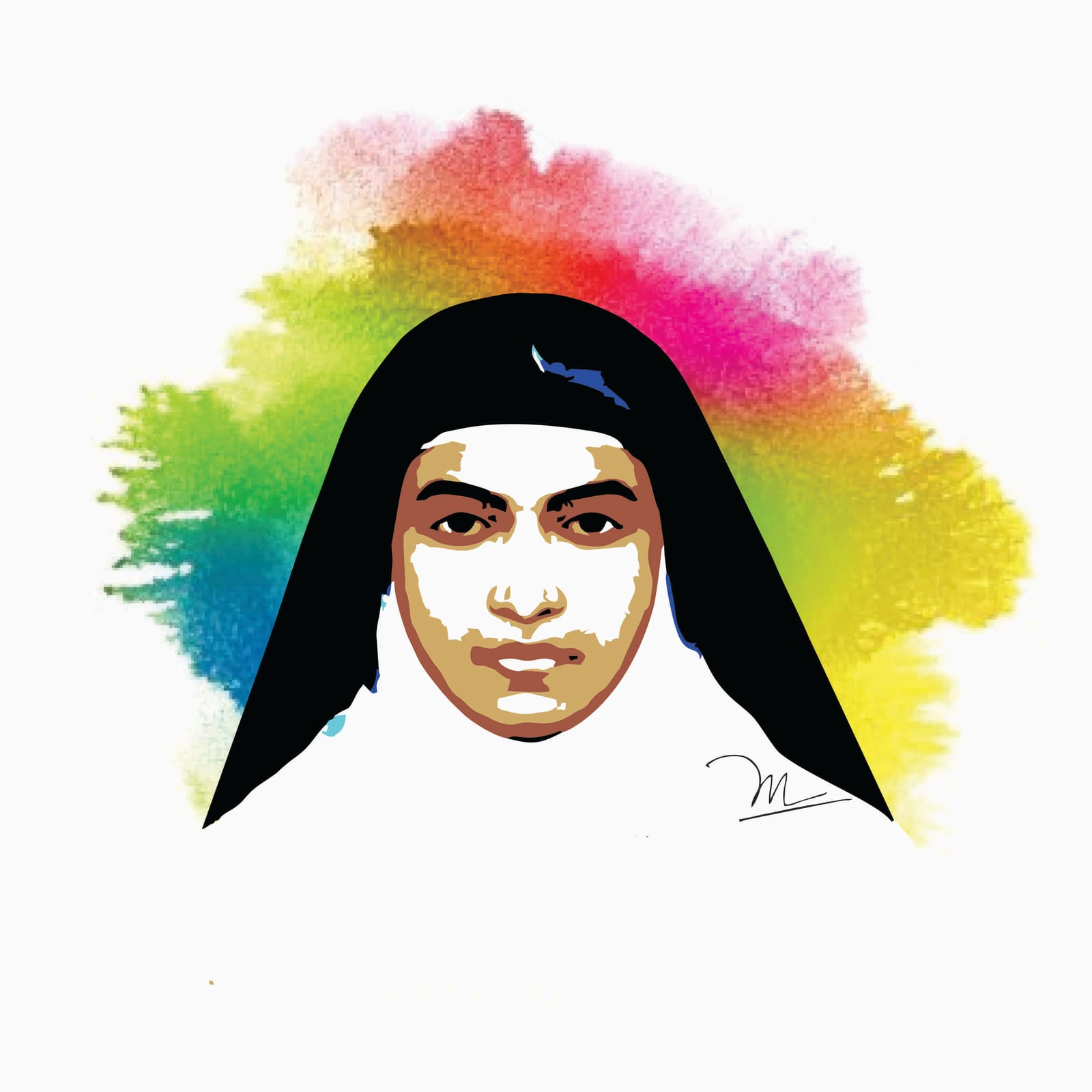
Annakkutty Muttathupadathu — the youngest of five children of a Syro-Malabar Catholic family of the Kottayam district of central Kerala — was orphaned of her mother as an infant. She was raised by her aunt. From childhood she rejected proposals of marriage. At sixteen she partly self-mutilated her foot by stepping into a pit of burning embers — an act she later acknowledged as deliberate self-injury to avoid forced betrothal and to confirm her religious vocation. She entered the Franciscan Clarist Congregation (FCC, the principal Syro-Malabar women's congregation, formally established 1888 by Mar Charles Lavigne) at Bharananganam in 1928 at seventeen.
Her life as a Clarist sister at Bharananganam (1928–46) was marked by sustained physical suffering. The foot injury never fully healed; recurrent severe infections, episodes of severe gastritis, malaria, pneumonia, and (from 1939) a sustained progressive illness that the medical observers of the period could not specifically identify (recent retrospective scholarship suggests possible auto-immune complications) reduced her to extended hospitalization periods. She accepted the suffering as substitutionary offering for the Syro-Malabar Catholic Church and for the conversion of India.
She died at Bharananganam on July 28, 1946 at thirty-five. The substantial dossier of cures attributed to her intercession — particularly cures of children with congenital deformities (perhaps a reflection of her own foot-injury sufferings) — began within months and became one of the most-attested 20th-century South Indian Catholic cult phenomena. Beatified by John Paul II at Kottayam in 1986 (the first papal beatification ever held in India). Canonized by Benedict XVI in 2008 — the first canonized Indian woman and the principal foundation figure of the modern Syro-Malabar Catholic Church.