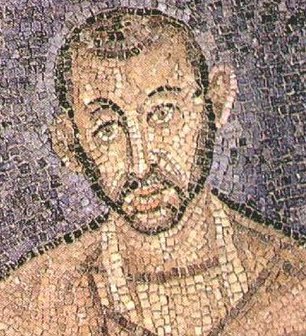
Ambrose was born to a Christian Roman family of senatorial rank — his father was the praetorian prefect of Gaul. Trained for law and public administration, he was appointed governor (consularis) of Aemilia-Liguria with residence at Milan. He was still a catechumen — not yet baptised — when, in 374, he intervened to prevent civil disorder at the contested episcopal election in Milan, and was himself acclaimed bishop by the crowd, Catholic and Arian alike.
He was baptised, ordained, and consecrated bishop within a week. He gave his estate to the Church and the poor, and threw himself into theological study under the priest Simplician. His eloquence in preaching and his force in administration made him the central public Christian figure in the Western empire. He baptised Augustine at the Easter Vigil of 387 — perhaps the single most consequential baptism in Western history.
He composed many of the Latin Church's greatest hymns — Veni Redemptor gentium, Aeterne rerum conditor, Deus creator omnium — and is the source of the 'Ambrosian rite' still used in the Archdiocese of Milan. In 390, after the massacre at Thessalonica, he barred the Emperor Theodosius from communion until the emperor performed eight months of public penance — the first time in Christian history a Christian bishop required public penance of a Christian emperor. He died on Good Friday, April 4, 397.
Bees on the Infant's Lips
Tradition holds that, when Ambrose was an infant, a swarm of bees alighted on his face and lips and went in and out of his mouth without harming him. His father interpreted this as a sign of future eloquence. The episode is the source of his patronage of beekeepers.
The Baptism of Augustine
Easter 387Augustine arrived in Milan in 384 a Manichee and skilled rhetorician, came under Ambrose's preaching, was converted, and was baptised by Ambrose at the Easter Vigil of 387. The Confessions devote an entire book to Ambrose's role in Augustine's conversion.
Discovery of the Bodies of Sts. Gervasius and Protasius
AD 386In 386, during a major confrontation with the Arian empress Justina, Ambrose dreamt of the location of the bodies of the two early martyrs. Excavating, his men found two great skeletons in perfect preservation. Translated to the basilica, the relics produced healings — most famously the cure of a blind butcher named Severus, attested in detail by Augustine, who witnessed it. The episode helped break Justina's pressure on the Catholic community.
Public Penance of the Emperor Theodosius
AD 390After Theodosius ordered a massacre of 7,000 in Thessalonica in 390, Ambrose excommunicated him and refused him communion for eight months until he performed public penance — the first time a Christian bishop disciplined a Christian emperor.
Sources & Further Reading