
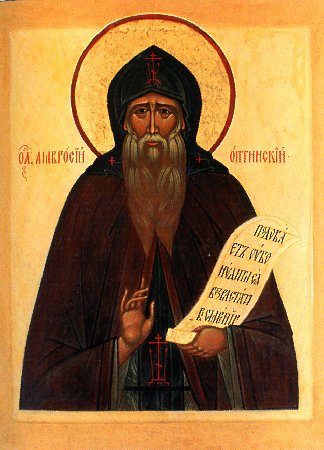
Aleksandr Grenkov was born to a small Tambov Russian Orthodox priest's family and studied at the Tambov diocesan seminary and the Lipetsk theological school. He served briefly as a parish singer and primary-school teacher in his early twenties before, in 1838, falling severely ill. After a vow that he would enter monastic life if recovered, he travelled — recovering — to the small Optina Pustyn monastery in the wooded backcountry south of Kaluga in October 1839.
Optina Pustyn was at that period an obscure provincial monastery that had become the Russian centre of a new ascetic-spiritual movement: the Elder (starets) tradition. The Russian elder Paissy Velichkovsky (1722–94) had, half a century before, translated and re-introduced the Greek Orthodox Hesychast tradition through the Philokalia and through the monastic restoration at Mount Athos and the Romanian monasteries; his Russian disciples had brought the renewed Hesychast tradition to Optina, where Elder Leonid (1768–1841) and Elder Macarius (1788–1860) had established the famous Skete of St. John the Baptist and the practice of public spiritual direction (starchestvo) of Russian Orthodox laity. Ambrose entered the small Optina community and rose through it across two decades.
On the death of Elder Macarius in 1860 Ambrose succeeded him as senior elder of Optina. For the next thirty-one years he served as spiritual director to a continuous stream of Russian Orthodox visitors — from peasants who walked hundreds of miles to consult him to writers and intellectuals of the entire Russian intelligentsia. Tolstoy visited him three times. Dostoevsky visited Optina in June 1878, three weeks after the death of his three-year-old son Alyosha; Dostoevsky's portrait of the Elder Zosima in The Brothers Karamazov (1880) draws directly on Ambrose. Vladimir Solovyov visited. Konstantin Leontiev was tonsured at Optina under Ambrose's direction. From 1884 he founded the new Shamordino Convent for women a few miles from Optina, where he died on October 10, 1891. Canonized in 1988 alongside thirteen other Optina Elders.