
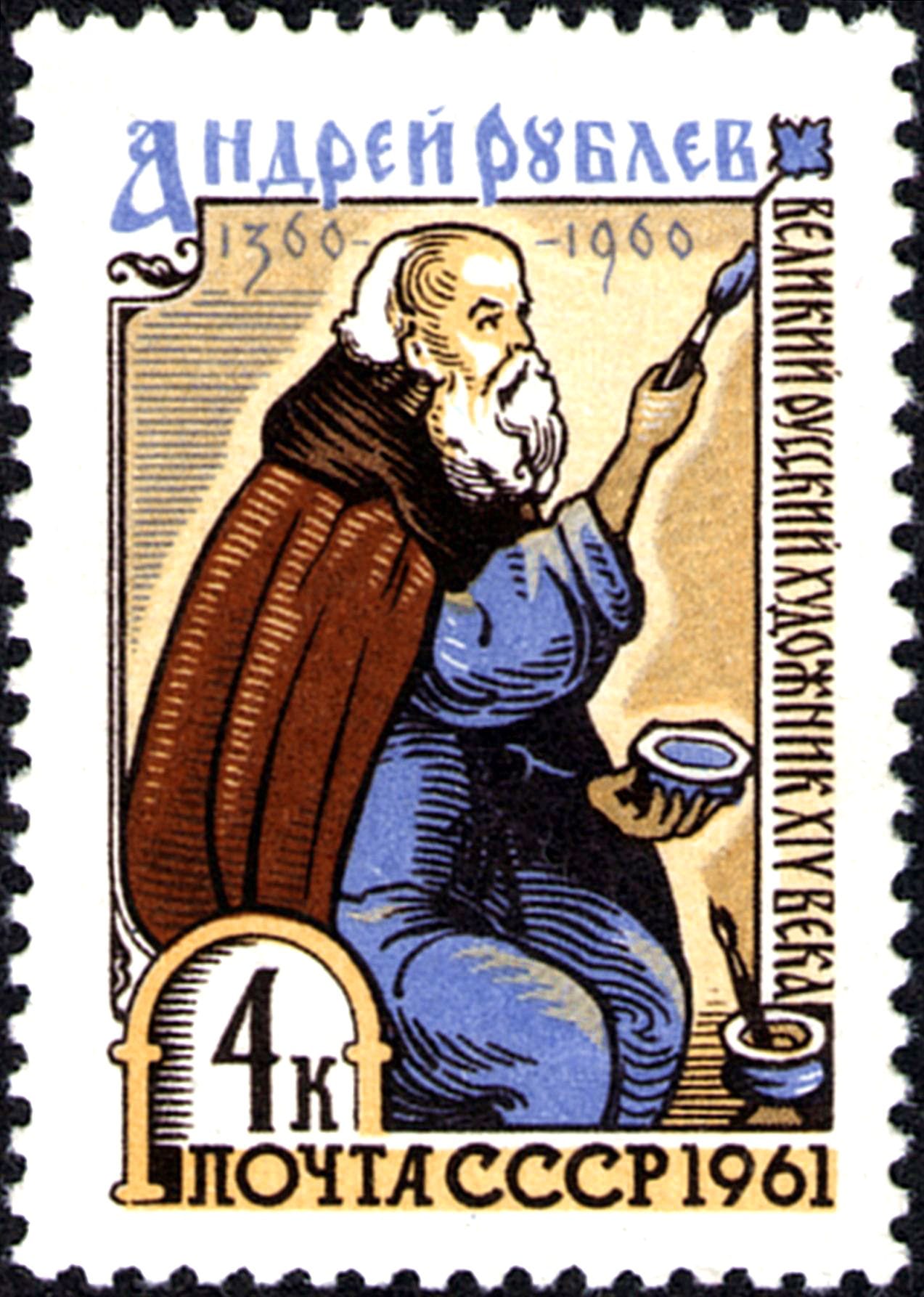
Andrei Rublev took monastic vows under the disciples of Sergius of Radonezh at the Trinity Lavra, and was formed in the Hesychast spirituality and the second generation of the Russian monastic revival. By the 1390s he was working as an iconographer; the chronicles record him in 1405 painting the Cathedral of the Annunciation of the Moscow Kremlin together with Theophanes the Greek and Prokhor of Gorodets, in 1408 painting the frescoes of the Cathedral of the Dormition at Vladimir together with Daniel Chorny, and in 1425–27 painting the iconostasis and frescoes of the Trinity Cathedral of the Trinity Lavra at Sergiyev Posad.
His supreme surviving work is the icon of the Hospitality of Abraham — usually called simply the 'Trinity' — painted for the iconostasis of the Trinity Cathedral around 1411 or 1425. Three angels are seated around a small altar-table with the cup at its centre, against the gold of the heavenly courts, with the oak of Mamre, the rock, and the house of Abraham softly behind them. The icon is at once a depiction of Genesis 18 (the visit of the three to Abraham, read by Christian tradition as a theophany of the Trinity) and a contemplative composition of the inner-Trinitarian communion — the three Persons turned to one another in an eternal exchange of love, and toward the viewer in welcome.
The 1551 Stoglav Synod, called by Tsar Ivan IV, declared Rublev's Trinity the canonical model for all subsequent Orthodox depictions of the Trinity. He died at the Spaso-Andronikov monastery in Moscow on January 29, 1430. After centuries of veneration as a holy iconographer, he was formally canonized by the Russian Orthodox Church on June 6, 1988 at the millennium of the Baptism of Rus'. His Trinity icon is preserved at the Tretyakov Gallery in Moscow.