
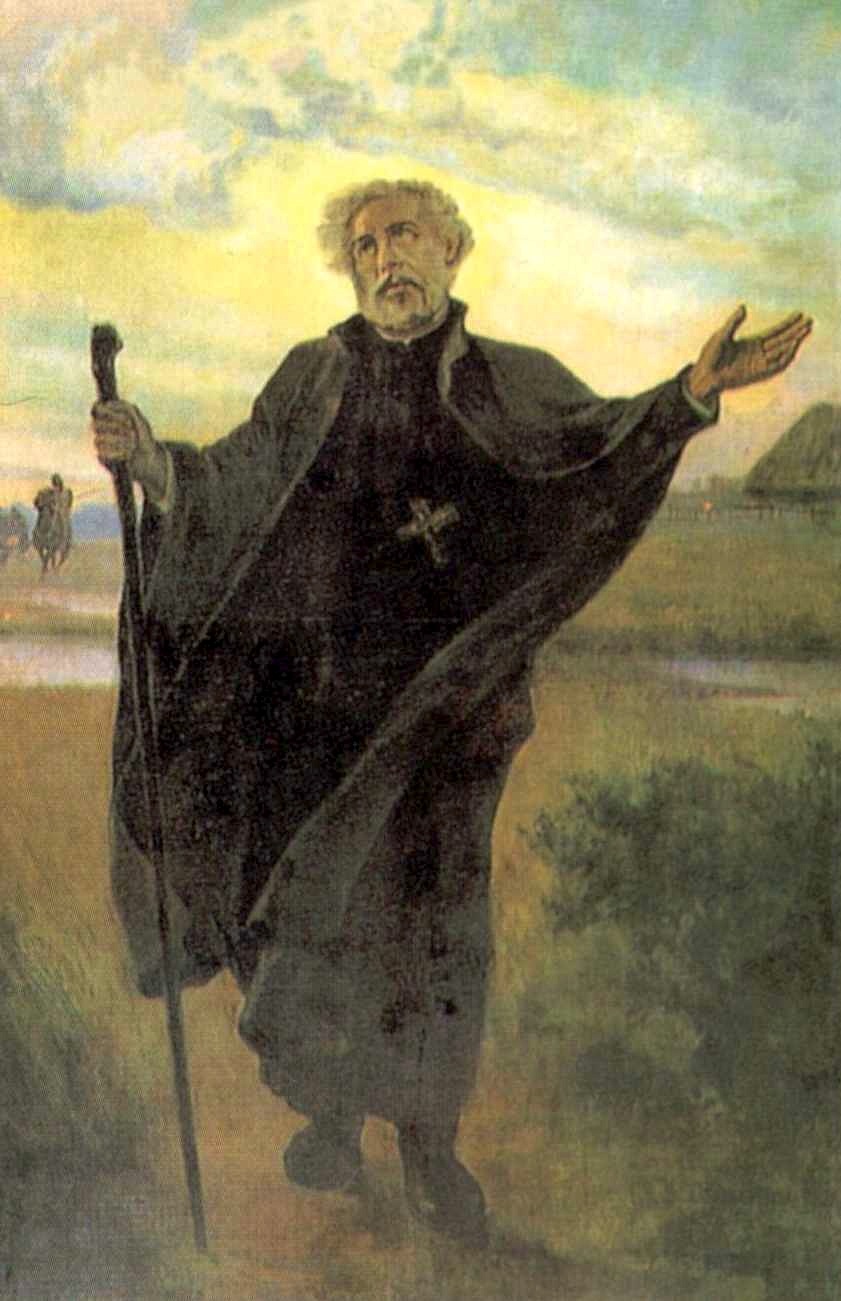
Andrzej Bobola was born to a noble Polish family in the Sandomierz region and entered the Society of Jesus at Vilnius in 1611. He was ordained priest in 1622 and served at major Jesuit houses across Poland-Lithuania — Vilnius, Płock, Warsaw, Łomża, Pińsk — primarily as preacher, confessor, and missionary in the heavily mixed Catholic-Orthodox-Lutheran-Jewish religious landscape of the eastern Polish-Lithuanian Commonwealth.
From the 1640s onwards he laboured especially in the Polesie region of what is now Belarus — the marshy, ethnically diverse eastern Polish-Ruthenian-Lithuanian frontier — preaching to Catholic, Orthodox, and undecided communities. He was famous for his accommodating disposition toward Orthodox Ruthenians (he received many through his preaching but always with respect for their traditions) and for his work in catechizing rural Polesie families.
In May 1657, during the long Khmelnytsky uprising and the consequent Cossack-Russian wars in the eastern Commonwealth (the so-called 'Polish Deluge'), Bobola was captured by a band of Cossacks near the village of Mohylna. He was tortured for two days — his face skinned alive, his eyes gouged out, the points of his teeth filed down with metal files, and finally killed by being hacked apart on a market table at Janów Poleski. His body was buried by the local Polesie Catholic community. The body was discovered substantially incorrupt several decades later and became the focus of an extraordinary popular cult that crossed Catholic-Orthodox boundaries. The Soviet authorities seized the body in 1922 for an anti-religious exhibition; it was returned to the Jesuits in 1924 and now rests in Warsaw. Canonized 1938.