
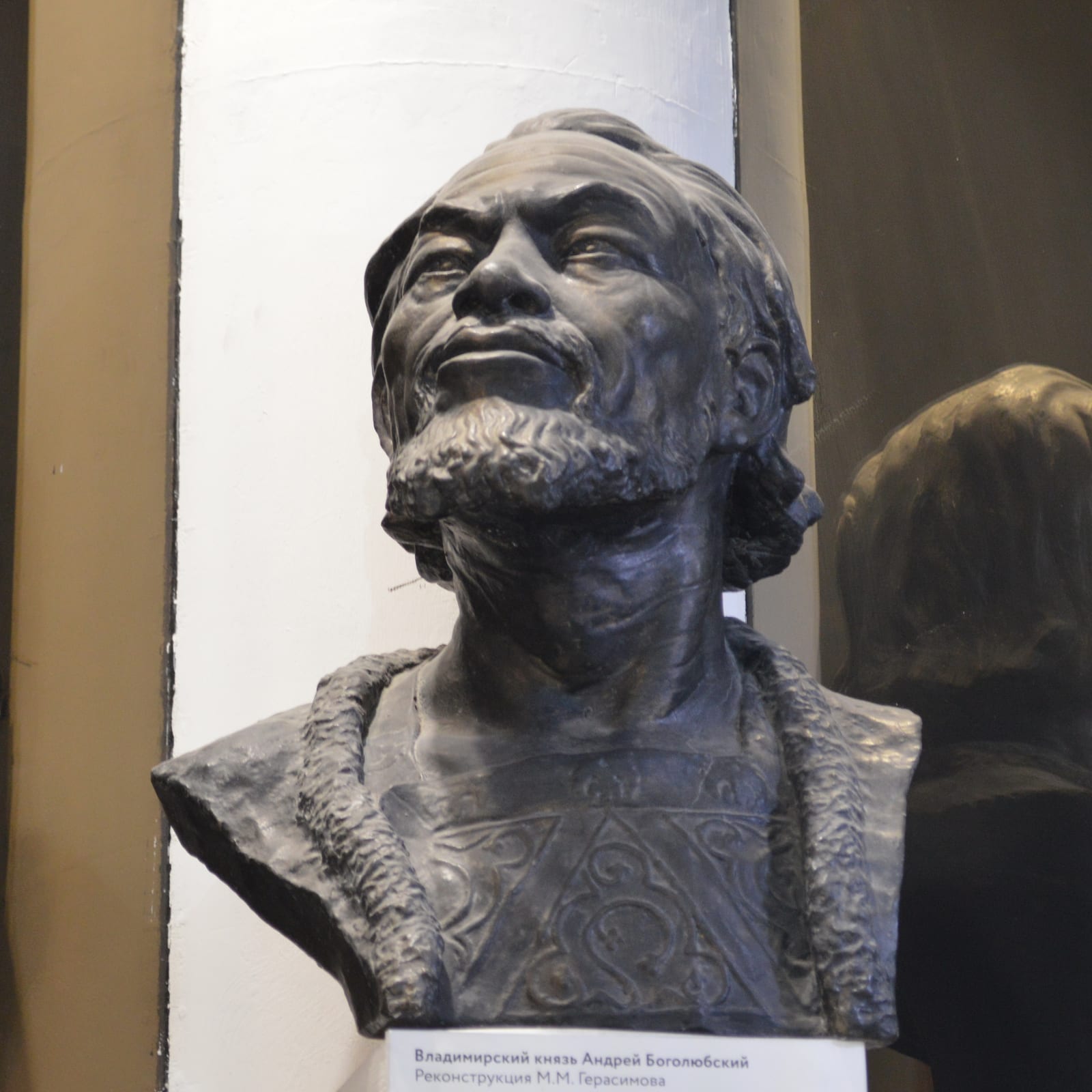
Andrew (Russian Андрей, surname Боголюбский — 'Bogolyubsky' meaning 'God-loving' or 'Beloved-of-God') was born around 1111 to Grand Prince Yuri Dolgoruky of Suzdal (the founder of Moscow on April 4, 1147) and his Polovtsian wife — the grandson of the great Grand Prince Vladimir Monomakh of Kiev.
Brought up at the royal Kievan-Suzdalian court, Andrew became distinguished for his personal piety, his Marian devotion, and his political-administrative ability.
Around 1155, Andrew took the institutional-political decision that would fundamentally re-orient the entire Russian-Slavic Catholic-Orthodox political-religious geography: departing from Kiev (the ancient Russian royal-religious capital, then under the governance of his father), he migrated north to Vladimir-Suzdal (the rising royal-religious centre of the northern Russian forests), bringing with him the famous Vladimir Theotokos icon (Russian Vladimirskaya Bogomater) — the ancient Byzantine icon of the Virgin and Child, one of the principal Marian icons of the Russian-Catholic-Orthodox tradition.
The translation of the Vladimir Theotokos icon — from Kiev to Vladimir — and the establishment of the royal-religious centre at Vladimir-Suzdal produced the decisive geographical-political shift that would re-orient the Russian Catholic-Orthodox history from the southern Kievan tradition to the northern Vladimir-Suzdalian-and-subsequently-Muscovite tradition that would produce the modern Russian Catholic-Orthodox national identity.
On his father's death in 1157, Andrew was elected Grand Prince of Vladimir-Suzdal (not Grand Prince of Kiev — the decisive institutional break with the ancient Kievan tradition). His seventeen-year reign (1157–1174) is the institutional founding period of the Vladimir-Suzdalian-and-subsequently-Muscovite Russian tradition.
Andrew built the principal architectural-religious monuments of the Vladimir-Suzdal period: the Cathedral of the Dormition (Uspensky Sobor) at Vladimir (built 1158–1160 to house the Vladimir Theotokos icon), the Golden Gate of Vladimir (built 1158–1164, modelled on the Golden Gate of Kiev), the famous Church of the Intercession on the Nerl (Pokrova na Nerli, built 1165, one of the principal Russian Catholic-Orthodox architectural monuments), and the royal palace at Bogolyubovo. The Vladimir-Suzdal White Monuments are a UNESCO World Heritage Site (inscribed 1992).
Most consequentially for the Russian-Slavic Catholic-Orthodox liturgical tradition, in 1164 Andrew institutionally established the annual celebration of the Feast of the Protection of the Theotokos (Pokrov / Pokrov Bogoroditsy) on October 1 — commemorating the vision of St. Andrew the Fool for Christ at the Blachernae Church in Constantinople (see the entry for St. Andrew the Fool for Christ). The Pokrov-feast — established by Andrew Bogolyubsky in 1164 as a Russian national-religious feast — became one of the principal Marian feasts of the entire eastern-Catholic Byzantine-rite Russian-Ukrainian-Belarusian-Slavic tradition to the present day.
Andrew was murdered at his royal palace at Bogolyubovo on the night of June 29, 1174 by a conspiracy of Boyar nobility — the tragic political assassination of the principal architect of the early Vladimir-Suzdalian royal-religious order. His immediate successors would continue the Vladimir-Suzdalian political-religious consolidation that would subsequently transfer the Russian royal-religious capital to Moscow.