
MIRACULOUS MIRACLES™

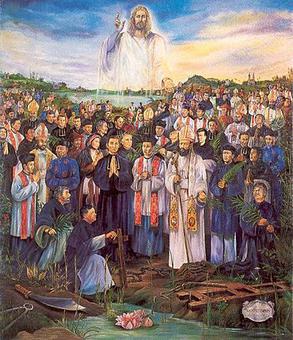
Saint — Andrew Dũng-Lạc and Companions

St. Andrew Dũng-Lạc and Companions
Various — 1745–1839 (the 117 individuals) — Various — 1745–1862 (representative date 1839, the year of Dũng-Lạc's death)
117 Vietnamese Martyrs of the Tonkin and Cochinchina Persecutions
Cathedral of St. Joseph, Hanoi, Vietnam
Feast
November 24
Canonized
June 19, 1988 by Pope John Paul II — 117 individuals canonized as a single group
✠ MartyrBeheaded at Cầu Giấy outside Hanoi, 1839 (representative of the 117 Vietnamese Martyrs) → The Martyrs
Life

The 117 Vietnamese Martyrs canonized together by Pope John Paul II at St. Peter's in 1988 represent the long ordeal of the Vietnamese Catholic Church under the Nguyễn dynasty (1820–1885), particularly during the reigns of Emperors Minh Mạng (1820–1841), Thiệu Trị (1841–1847), and Tự Đức (1847–1883). Vietnamese Catholicism had been planted in the 17th century by Portuguese and Spanish Dominicans and especially by the French Jesuit Alexandre de Rhodes (who created the romanized quốc ngữ script still used by modern Vietnam). By 1820 the Vietnamese Catholic Church had perhaps half a million members.

The persecution intensified after 1832 under Minh Mạng's anti-Catholic edicts and culminated in the long bloody campaigns of Tự Đức in the 1850s and 1860s. Catholics — clergy, religious, and lay — were beheaded, hanged, strangled, dismembered, branded, exiled, and starved in numbers that historians have estimated between 100,000 and 300,000 across the long persecution. The 117 canonized of 1988 include 96 Vietnamese, 11 Spanish Dominicans (of the Manila Dominican province that staffed Tonkin), and 10 French (Société des Missions Étrangères de Paris). Their representative is Andrew Dũng-Lạc, a Vietnamese diocesan priest born around 1795 who was beheaded at Cầu Giấy outside Hanoi on December 21, 1839 — the year of his death is the conventional date used for the collective group.

The Vietnamese Catholic Church survived the persecutions — by the end of the 19th century the Catholic population had grown back to nearly a million, and by 2024 it numbers over seven million, the second-largest Christian community in Southeast Asia. Beatification dossiers for the various persecutions were processed across the 19th and 20th centuries; John Paul II's 1988 single canonization grouped them all and remains the largest single canonization in church history (until the 800 Martyrs of Otranto canonization of 2013).

Miracles & Phenomena
  • The 117 individual martyrdoms

    The 117 individual martyrdom accounts — many recorded in detail by surviving Catholic communities and the French Société des Missions Étrangères — form the basic devotional dossier of Vietnamese Catholic memory: priests beheaded clutching their breviaries, laymen burned alive for refusing to trample on crucifixes, women strangled in family groups, catechists branded on the face and exiled to malarial provinces.

Relics
  • Object
    Relics of the Vietnamese Martyrs
    Cathedral of St. Joseph, Hanoi; Saigon Cathedral; relics distributed at parish level across all 26 Vietnamese dioceses and the Vietnamese diaspora

    Substantial relics of dozens of the individual martyrs are distributed at parish-level across Vietnam, particularly in the dioceses of Bùi Chu, Phát Diệm, Vinh, Hanoi, and Saigon. Major collective shrines are at the Cathedral of St. Joseph in Hanoi and at the Vietnamese Martyrs Shrine of Saigon.

Iconography
  • The Vietnamese Martyrs at the cangue

    The 117 martyrs in traditional Vietnamese áo dài and Catholic vestments, the heavy wooden cangue around their necks, a banner with the Vietnamese romanized inscription Vinh quang Việt Nam Tử Đạo ('Glory to the Vietnamese Martyrs') above — the iconography of the collective canonization.

Patronages
VietnamVietnamese Catholics worldwideVietnamese diasporaCatechumensRefugeesDiocese of Bùi Chu (the heart of the persecution)