
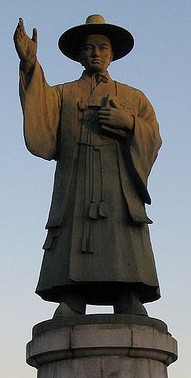
Korean Catholicism is the only major church planted entirely without foreign missionaries: it began in 1784 when Yi Seung-hun, a young Korean Confucian scholar from Seoul, was baptized in Beijing and returned to Korea to evangelize. Within a few years a small underground Korean Catholic community had grown to several thousand without any priest. Foreign priests were prohibited from entering Korea by the Joseon dynasty until the late 19th century; the small Korean Catholic community was sustained by lay catechists and the occasional clandestine French missionary.
The 103 Korean Martyrs canonized together by John Paul II at Seoul on May 6, 1984 represent the long ordeal of Korean Catholicism under successive persecutions: the Sinyu persecution of 1801, the Eulhae persecution of 1815, the Gihae persecution of 1839 (the most extensive, in which the first foreign bishop of Korea, Pierre-Philibert Maubant, MEP, was killed), the Byeongo persecution of 1846, and the catastrophic Byeongin persecution of 1866–67, in which an estimated 8,000–10,000 Korean Catholics were killed under the regent Heungseon Daewongun.
Their representative is Andrew Kim Tae-gon (1821–1846), the first ordained Korean Catholic priest. The son of Korean Catholic gentry, Andrew was sent at fifteen to Macau where he studied at the General College of the Missions Étrangères de Paris under the future apostolic vicar of Korea Jean-Joseph Ferréol. He was ordained at Shanghai in 1845, the first ethnic Korean priest in church history, returned to Korea by sea, ministered clandestinely in Seoul for a few months, was arrested at sea near the West Coast on June 5, 1846, and was beheaded at Saenamteo on the Han River outside Seoul on September 16, 1846 at twenty-five — the conventional date for the collective canonization.
Korea became one of the great Catholic success stories of the late 20th century — from the small underground church of the persecutions to the vital national church of today, with over five million Catholics. The 1984 Seoul canonization was the largest single canonization in church history at that date (subsequently exceeded by the 117 Vietnamese Martyrs in 1988 and the 800 Otranto Martyrs in 2013).