
MIRACULOUS MIRACLES™

Saint — Andrew the Fool for Christ

St. Andrew the Fool for Christ
c. 870 AD, Scythian (Slavic) territory (taken to Constantinople as a slave) — c. 936 AD, Constantinople
holy fool of Constantinople; vision of the Theotokos protecting the city
Blachernae Church (Church of the Theotokos at Blachernae), Constantinople — the scene of his vision of the Protection of the Theotokos (Pokrov / Pokrov Mary), the origin of the Slavic Catholic-Orthodox Feast of the Protection of the Theotokos (October 1), Turkey
Feast
October 2 (Eastern Catholic and Orthodox); the related Feast of the Protection of the Theotokos (Pokrov) is October 1
Canonized
Pre-congregation; venerated jointly in the eastern-Catholic Byzantine-rite and Orthodox calendars as the holy fool (Salos) of Constantinople
Life

Andrew was born around 870 in Scythian (Slavic Eastern European) territory and taken as a slave to Constantinople, where he served in the household of the Byzantine imperial bodyguard Theognostus.

After Christian formation in the household, he received a vision calling him to the distinctive vocation of the 'Fool for Christ' (Greek Salos, taking up the Pauline-Corinthian phrase 'we are fools for Christ's sake') — abandoning the household to live on the streets of Constantinople, feigning insanity, enduring beating and ridicule, giving away whatever the faithful gave him to the poor, and exercising the hidden charism of spiritual discernment and prophecy.

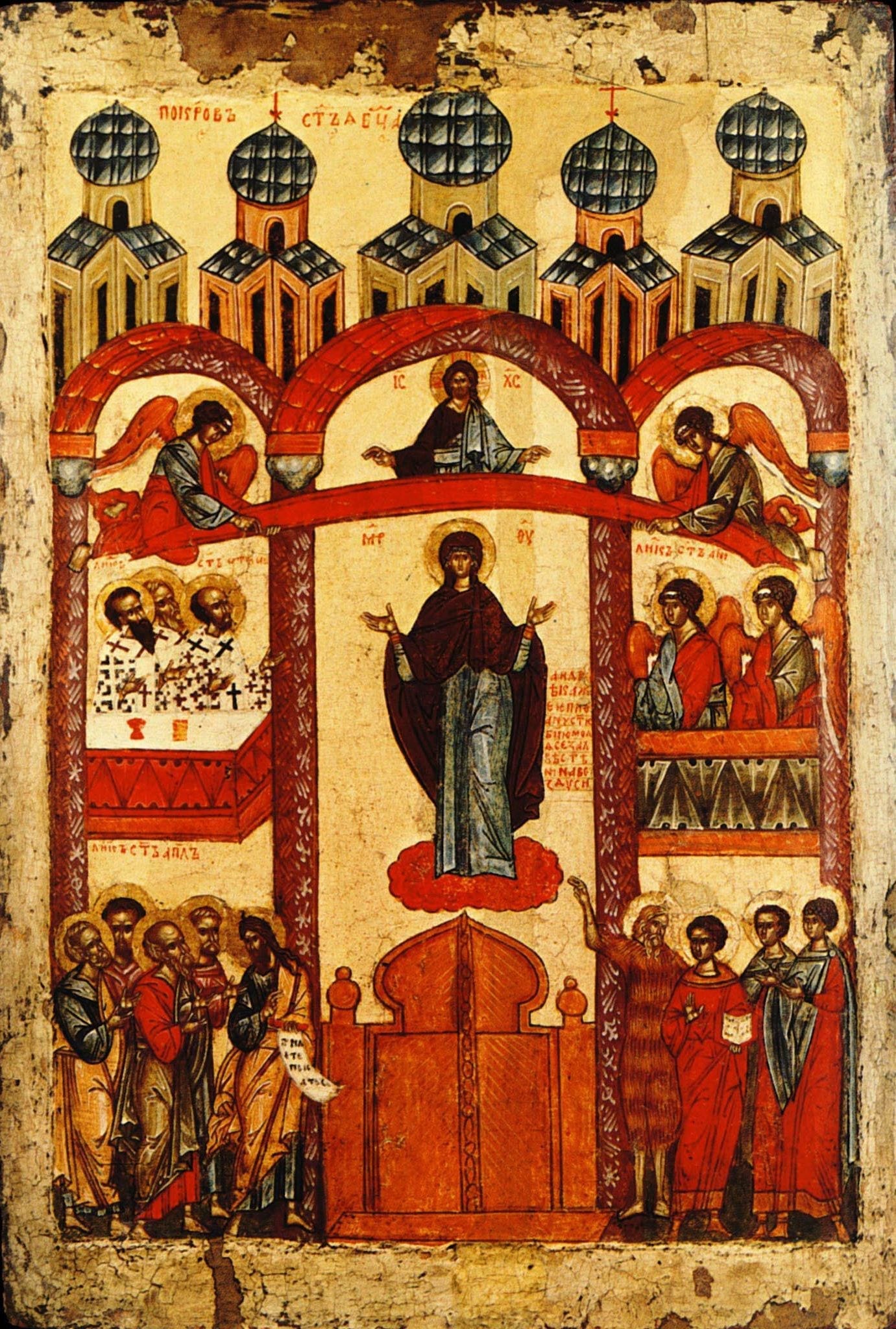
He is most renowned in the eastern-Catholic Byzantine-rite and Orthodox tradition for the vision at the Blachernae Church on a night in the early 10th century — when the city of Constantinople was besieged by Saracen / Slavic enemies (variously identified): Andrew and his disciple Epiphanius saw the Mother of God herself standing above the congregation in the Blachernae Church, spreading her maphorion (the outer veil) over the worshipping faithful as a sign of her maternal protection of the city.

The vision became the origin of the eastern-Catholic Byzantine-rite and Orthodox Feast of the Protection of the Theotokos (Pokrov / Pokrov Bogoroditsy) — established in the Russian / Slavic Orthodox-Catholic calendar by Prince Andrew Bogolyubsky of Vladimir in 1164 as a national feast (October 1), and one of the principal Marian feasts of the Slavic Catholic-Orthodox liturgical year to the present day.

Andrew died on the streets of Constantinople around 936; his disciple Nicephorus the priest of Hagia Sophia composed his Greek Vita (preserved in the Byzantine hagiographical corpus), which became the primary literary template of the entire Byzantine-Russian holy-fool (yurodivy) tradition that would produce Sts. Basil Fool-for-Christ of Moscow (16th c.), Xenia of St. Petersburg (18th c.), and the continuing Catholic-Orthodox 'fool for Christ' charism.

Miracles & Phenomena
  • The vision of the Protection of the Theotokos at Blachernae

    Andrew's vision at the Blachernae Church of the Theotokos extending her maphorion (outer veil) over the worshipping Catholic-Christian faithful of besieged Constantinople — and the establishment by Prince Andrew Bogolyubsky of Vladimir of the annual Feast of the Pokrov (Protection of the Theotokos) on October 1 — is the institutional origin of the principal Slavic Marian devotion of the entire eastern-Catholic Byzantine-rite and Orthodox tradition. The Pokrov-feast remains the principal Marian feast of the Russian, Ukrainian, Belarusian, Serbian, Bulgarian, and Greek Catholic and Orthodox liturgical calendars to the present day.

  • The holy-fool tradition

    Andrew's adoption and living of the 'Fool for Christ' (Salos) vocation established the distinctive Byzantine-Russian Catholic-Orthodox spiritual tradition of holy folly — the deliberate adoption of outward insanity as a vehicle for hidden spiritual discernment, prophetic confrontation of worldly power, and radical Pauline-Corinthian 'foolishness of the Cross'. The Russian yurodivy tradition that Andrew inspired produced Sts. Basil of Moscow, Xenia of St. Petersburg, and the continuing Catholic-Orthodox holy-fool charism to the present day.

Relics
  • Body
    Relics of St. Andrew the Fool for Christ
    Constantinople — fragmentary relics preserved at the Ecumenical Patriarchate (Phanar, Istanbul) and at Mount Athos; the Blachernae church site (now an Ottoman-era and modern Greek Orthodox church in the Ayvansaray district of Istanbul) preserves the tradition

    His relics have largely been dispersed; fragmentary relics survive at the Ecumenical Patriarchate and Mount Athos. The Blachernae church site in modern Istanbul preserves the pilgrim tradition of the vision-of-the-Protection.

Iconography
  • Andrew and Epiphanius beholding the Pokrov vision

    The early-10th-century Scythian-Slavic holy fool in ragged garments at the Blachernae Church beside his disciple Epiphanius, both gazing upward at the vision of the Theotokos extending her maphorion-veil over the congregation below — the standard eastern-Catholic Byzantine-rite and Orthodox iconography of the Pokrov feast, reproduced in every Slavic Catholic-Orthodox church for the October 1 liturgy.

Patronages
Catholic and Orthodox 'fools for Christ' (Salos / yurodivye) traditionCatholic and Orthodox Slavic Christian peoples (especially Russian, Ukrainian, Belarusian)Catholic Eastern European converts from slaveryThe Slavic Catholic-Orthodox feast of the Protection of the Theotokos (Pokrov, October 1)