
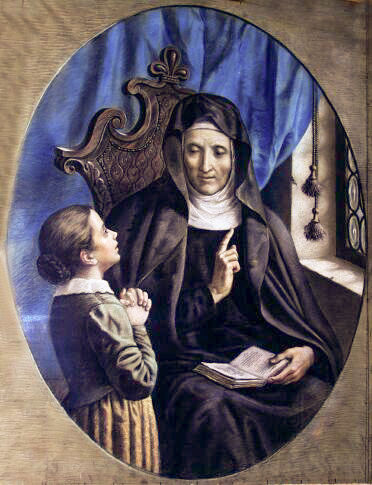
Angela Merici was orphaned at ten in a small Lombard family of modest means and was raised by an uncle at Salò on Lake Garda. She entered the Franciscan Third Order at sixteen, made a private vow of virginity, and lived as a tertiary while working as a lay catechist with the village girls of her area — an extension of the older tradition of village pious widows teaching girls without formal religious enclosure.
She moved to Brescia in 1516 at the invitation of a noble family who sought her direction. Brescia in the 1520s and 1530s was a city devastated by war (the 1512 sack by the French had killed half the population), plague, and the early Protestant pamphlet wars. Angela's work expanded into a circle of similar women catechists, and on November 25, 1535, in the small church of Sant'Afra in Brescia, she gathered twenty-eight women — most under thirty — and formally constituted the Company of St. Ursula. The Company took private vows of virginity but, crucially and revolutionarily, did not take formal religious habit, did not live in enclosed communities, and remained in their own homes or family situations: a startling innovation that opened consecrated life to women who had no family financial capacity for a conventional dowry-dependent monastic vocation.
She died at Brescia on January 27, 1540, three months after Pope Paul III formally confirmed the Company. After her death the Ursulines (named after the patroness St. Ursula) developed in two directions: in northern Italy and France they became — over the next century — enclosed teaching religious of the conventional kind, transformed by Charles Borromeo (who promoted them) into the first major women's teaching order, focused on the formal Christian education of girls. In Quebec, the Ursulines founded the first school for girls in North America (Marie of the Incarnation, 1639). Canonized 1807, Angela Merici is the foundress of women's teaching religious life in the modern Catholic Church.