
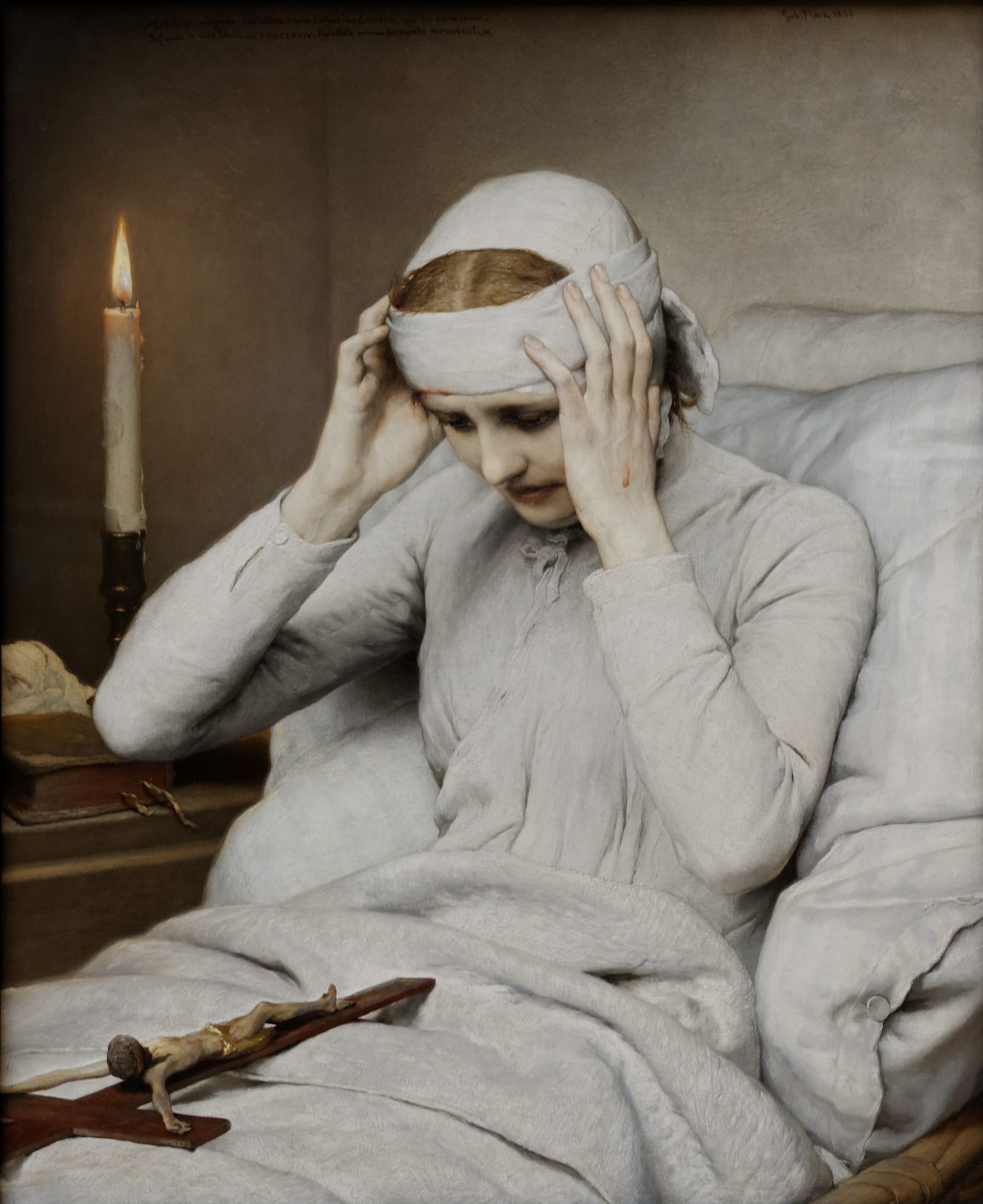
Anna Katharina Emmerich was born on September 8, 1774 at Flamske in the Prince-Bishopric of Münster to a German peasant family. In 1802, at the age of 28, Anna Katharina entered the Augustinian Monastery of Dülmen.
In 1811, the Napoleonic secularization suppressed the Augustinian Monastery of Dülmen. Anna Katharina continued the monastic vocation at a private residence in Dülmen.
In 1812, Anna Katharina received the stigmata — the marks of the Passion of Christ on her body — and undertook the 12-year vocation of the visionary of the Passion (1812–1824).
Anna Katharina dictated multiple visions of the life of Christ, the Blessed Virgin, and the apostles to the German Romantic poet Clemens Brentano (1778–1842) — producing the 'Emmerich-Brentano' visionary corpus. The corpus includes: 'The Dolorous Passion of Our Lord Jesus Christ' (Bittere Leiden unseres Herrn Jesu Christi, published 1833) and 'The Life of the Blessed Virgin Mary' (Das Leben der Heiligen Jungfrau Maria, published 1852).
Anna Katharina's vision of the House of Mary at Ephesus — locating the dwelling of the Blessed Virgin's last years — led to the 1881 discovery of the Meryem Ana Evi (House of the Blessed Virgin Mary) at Ephesus by Fr. Julien Gouyet, a site now recognized by the Catholic Church as a pilgrim destination.
She died at Dülmen on February 9, 1824 at the age of 49.
Mel Gibson's 2004 film 'The Passion of the Christ' drew extensively on Anna Katharina's 'Dolorous Passion' — establishing the Emmerich-Brentano tradition in the modern Catholic imagination.