
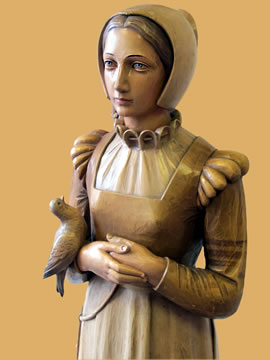
Anne Heigham was born to a Calvinist gentry family in Essex; both she and her brother William were disowned and disinherited as teenagers when they converted to Catholicism. She married another disinherited convert, Roger Line, around 1583. Roger was arrested for attending Mass within two years and exiled to Flanders, where he died in 1594, leaving Anne destitute.
The Jesuit superior in England Father John Gerard recruited her to act as housekeeper of a clandestine Catholic safe house in central London — a 'Mass-centre' for hunted recusant Catholics and the Jesuit missionary priests who served them. She managed the house for several years through frequent searches, supporting it financially by needlework and lacemaking, and was personally responsible for hiding several priests including Gerard himself during his celebrated escape from the Tower in October 1597.
On February 2, 1601, the feast of the Purification of the Virgin — a major Catholic feast then strictly forbidden in England — Anne organized a Mass at her house for a large gathering of recusants. The priest, Father Francis Page, escaped through the priest-hole; Anne was arrested. She refused at her trial to plead anything except guilty to harbouring priests, was sentenced to death, and was hanged at Tyburn on February 27, 1601 — the last woman martyred under Elizabeth I. Beside her on the same gallows were the Jesuits Roger Filcock (her own confessor) and Mark Barkworth. Canonized 1970.