
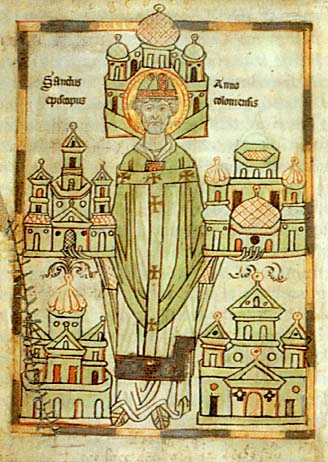
Anno was born around 1010 to a noble Swabian family at Steußlingen, educated at the cathedral school of Bamberg under Bishop Suidger (the future Pope Clement II). He became provost of Goslar and the personal chaplain of Emperor Henry III (1039–1056).
In 1056, on the death of Archbishop Hermann II of Cologne, Henry III appointed Anno as Archbishop of Cologne — taking up the governance of the principal Rhineland Catholic see at the age of 46.
Henry III died on October 5, 1056, leaving his five-year-old son Henry IV as king under the regency of his mother Empress Agnes of Poitou. The regency produced the political crisis of the late 1050s and early 1060s, culminating in the famous Coup of Kaiserswerth (April 1062): Anno, allied with Count Egbert of Brunswick and Archbishop Adalbert of Bremen, invited the 12-year-old Henry IV onto a ship on the Rhine at Kaiserswerth (near Düsseldorf) — and seized the boy-king, separating him from his mother and seizing the regency for the German princes.
Anno served as principal regent for Emperor Henry IV from 1062 to 1065, shaping the young emperor's political-religious education during the years that would produce his confrontation with Pope Gregory VII in the Investiture Controversy.
He founded around 1064 the Abbey of Michaelsberg at Siegburg in the Bergisches Land of the Rhineland — the principal Cologne monastic foundation that would become the principal Anno-shrine; the abbey survives in continuous Catholic Benedictine liturgical use.
He also founded the abbeys of Grafschaft, Saalfeld, and the Abbey of St. George at Cologne — producing the extensive Anno-monastic federation across the Cologne archdiocese.
Anno died at Cologne on December 4, 1075. His canonization in 1183 by Pope Lucius III established his cult; the Old High German vernacular poem 'Annolied' (Song of Anno) — composed c. 1080 at the Siegburg Abbey, one of the earliest Old High German vernacular poems — celebrates his episcopal-and-political career as the German-Catholic episcopal exemplar.