
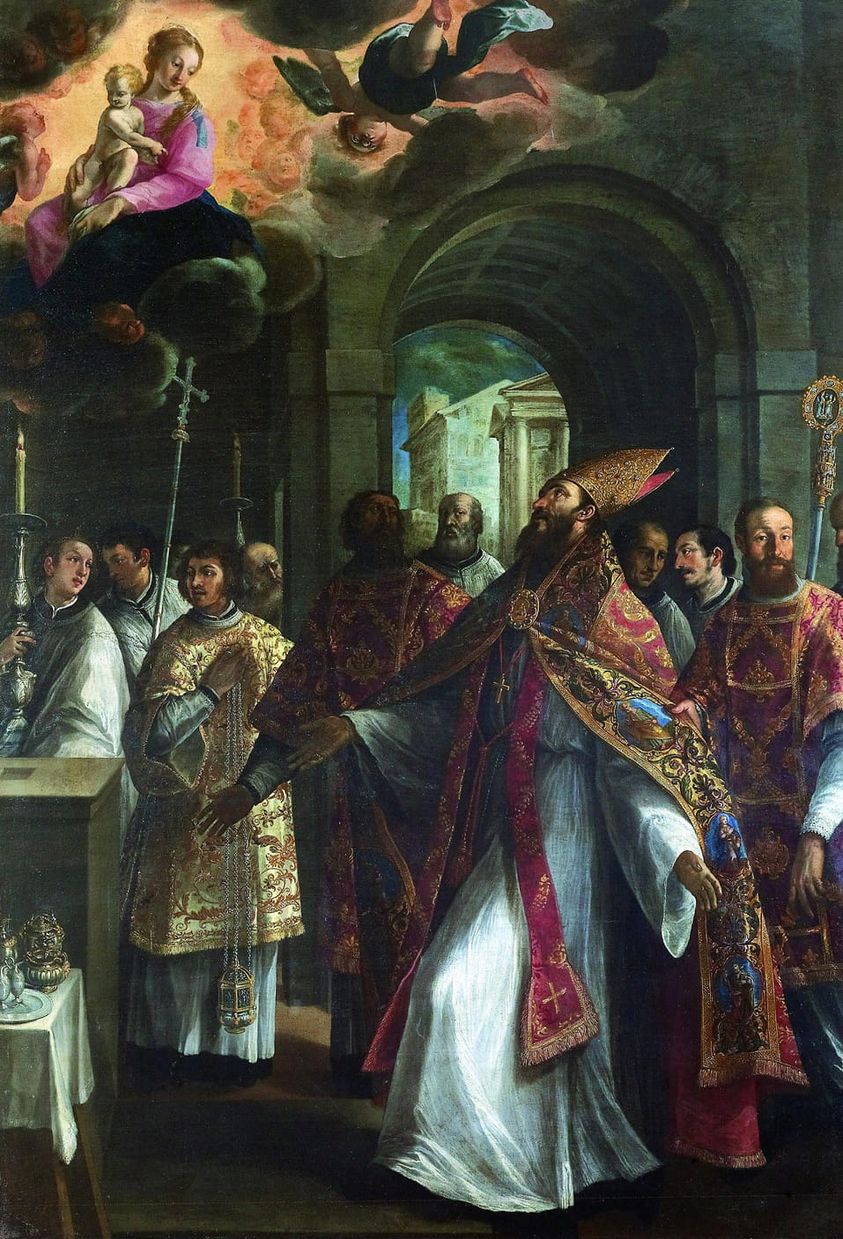
Anselm — known as 'Anselm the Younger of Lucca' to distinguish him from his uncle Anselm of Lucca (Anselm the Elder, the bishop of Lucca who became Pope Alexander II in 1061) — was born around 1036 in Mantua to a noble Lombard family.
Educated at the cathedral school of Mantua and at the Abbey of Cluny under Abbot Hugh of Cluny (the principal Cluniac abbot of the High Medieval period), Anselm became a monk of the Cluniac tradition.
His uncle Pope Alexander II appointed him Bishop of Lucca in 1073 — the principal Tuscan see controlled by the reforming party. Anselm initially declined the appointment; on his uncle's death the same year (April 21, 1073) and the election of Hildebrand of Sovana as Pope Gregory VII (April 22, 1073), the new pope personally confirmed Anselm's appointment.
Anselm's thirteen-year episcopate at Lucca (1073–1086) was devoted to the Lucchese clerical reform — enforcing the Gregorian disciplines of clerical celibacy and anti-simoniacal canonical regulations. His reform-enforcement provoked the anti-Gregorian Lucchese clerical-popular revolt of 1080, which drove Anselm from his see; the rest of his life was spent in exile at the Mantuan court of the Margravine Matilda of Tuscany (one of the principal political defenders of the Gregorian papacy).
Most consequentially for the High Medieval Catholic tradition, Anselm of Lucca composed the Collectio Canonum Anselmi Lucensis ('Collection of Canons of Anselm of Lucca', c. 1083) — the principal canon-law collection of the Gregorian Reform period. The collection systematized the papal-decretal-and-conciliar canonical tradition into 13 books, arranged the thematic and doctrinal material to support the Gregorian-Reform programme (papal supremacy, ecclesiastical liberty from secular control, clerical celibacy, anti-simoniacal canonical-and-spiritual discipline).
The Collectio Anselmi became one of the principal canonical sources of the Decretum Gratiani (c. 1140, the principal canon-law collection of medieval Western Catholicism) — and through Gratian, an institutional source of the entire Catholic canon-law tradition.
He died at Mantua on March 18, 1086, and was buried at the Basilica of Sant'Andrea — where his tomb survives today.