
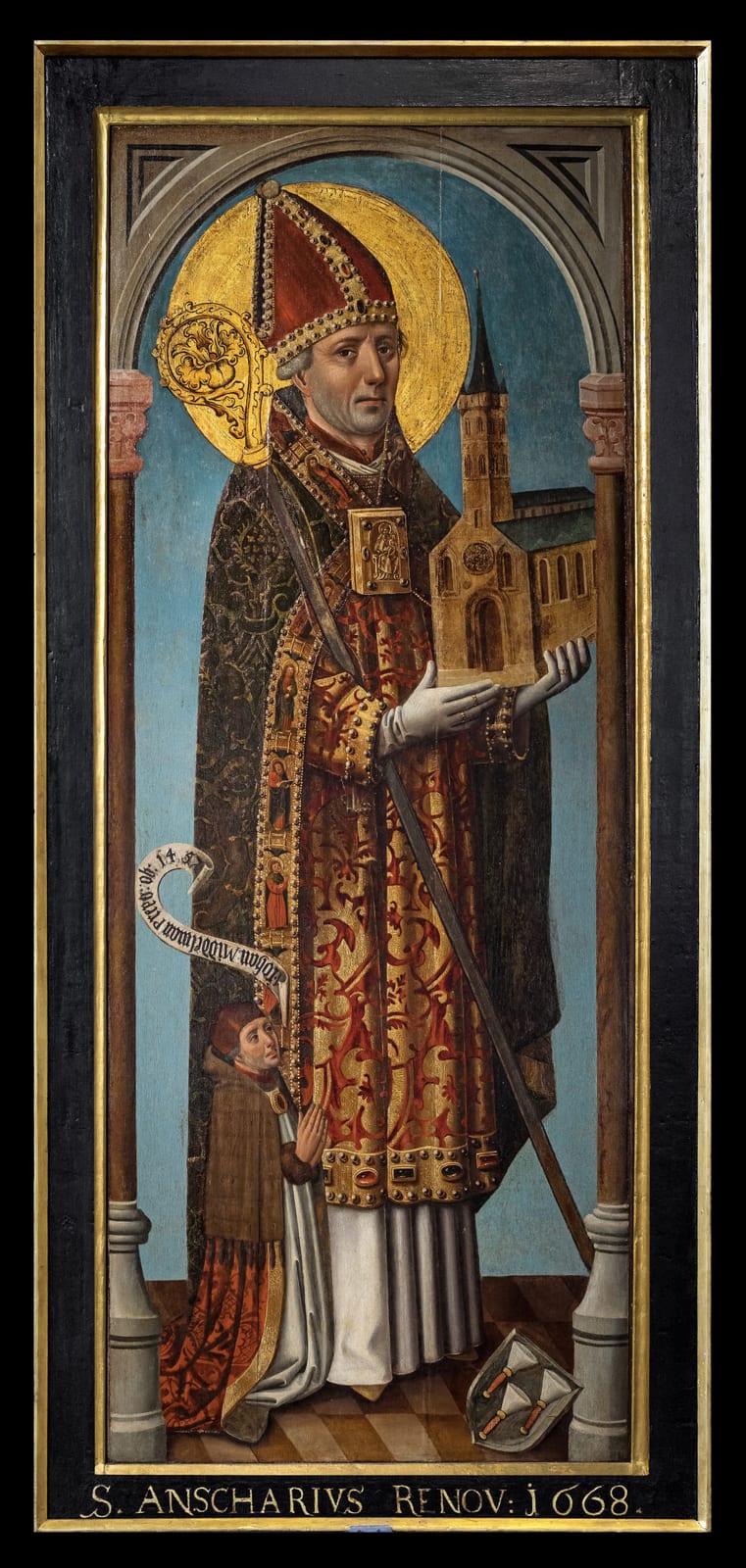
Ansgar was a monk of Corbie in Picardy, given to the monastery as a child after his mother's death, and went from there to the new foundation of Corvey in Saxony. In 826 the Frankish court sent him north with Harald Klak, a Danish king who had just been baptised at Mainz and was returning to claim his throne; Harald fell within the year and the school Ansgar had opened fell with him. In 829 he went further, to Birka on Lake Mälaren in Sweden, the trading town of the Svear, and was received there by the king and by his steward Hergeir, who was baptised and built the first church in Sweden on his own land.
Louis the Pious made him bishop of a new see at Hamburg in 831, planted at the edge of the empire to face the north, and Gregory IV named him papal legate to the Danes, Swedes and Slavs. In 845 a Danish fleet came up the Elbe and burned Hamburg to the ground, church, library and all, and Ansgar was a bishop with no city. He was given the vacant see of Bremen in 847 and the two were united, a union Nicholas I confirmed in 864. He went back to Sweden himself around 852, when the mission there had all but died, and won leave from the king and the assembly for the Faith to be preached again.
His successor Rimbert wrote his life within a few years of his death, and it is one of the best-attested lives of the ninth century. Rimbert records the saying by which Ansgar is remembered: told that people credited him with miracles, he answered that if he were worthy of any favour from God he would ask for one miracle only, that God would make him a good man. Almost everything he built was destroyed at least once in his lifetime, and Scandinavia was not Christian for another century and a half; the Church calls him its apostle anyway, because he began.