
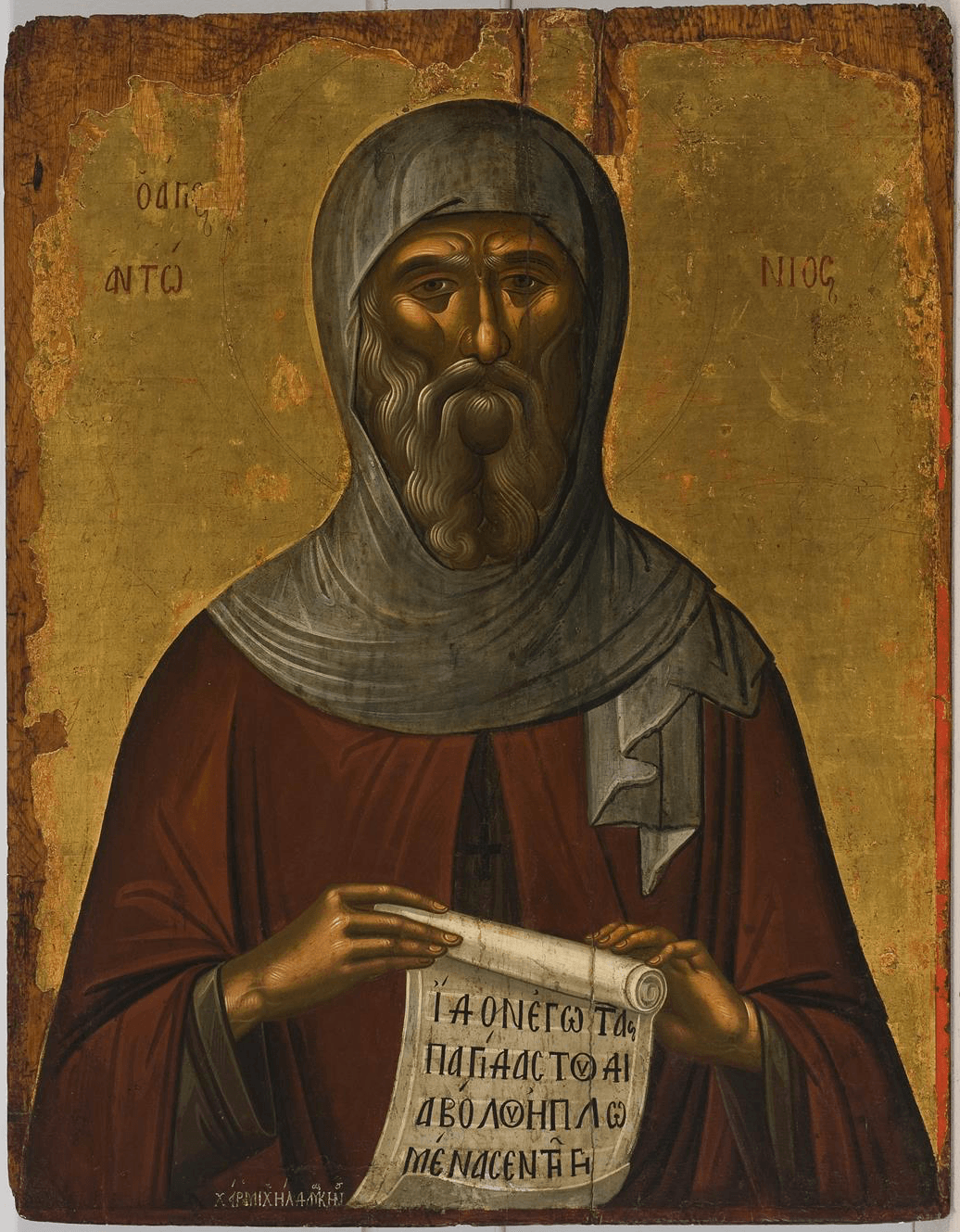
Anthony was the son of well-to-do Christian farmers of Coma in Upper Egypt. At twenty, after the death of his parents, he heard read in church the Gospel: 'If thou wilt be perfect, go, sell what thou hast, and give to the poor.' He took it as said personally to him. He gave away his inheritance, placed his sister with a community of virgins, and went into the desert.
For some twenty years he lived in increasing solitude — first in a tomb, then in an abandoned fort on the mountain — wrestling with the temptations of the devil (the famous 'Temptations of St. Anthony' of medieval and modern art) and growing in prayer. Disciples gathered around him; he became, in the words of Athanasius's Life of Anthony (357), 'the father and physician of all Egypt.'
He left the desert twice — once during the Diocletianic persecution to encourage the martyrs at Alexandria, and again in his old age to defend the orthodox faith against Arianism at the request of his friend St. Athanasius. He died at one hundred and five on his mountain, with two disciples beside him, leaving instructions that his burial place be kept secret.
The Life of Anthony by Athanasius became, after the Gospels and Augustine's Confessions, the most widely read Christian biography in the early Middle Ages. It launched the spread of monasticism across the Mediterranean — directly inspiring Pachomius, Basil, Martin of Tours, and Augustine.