
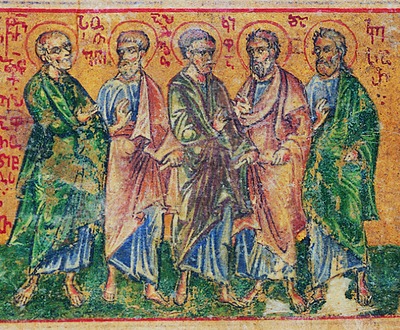
Apollos (Greek Apollos, a contraction of the longer Greek name Apollonios) was a Jewish Christian from Alexandria — the great centre of Hellenistic Jewish learning and the home of Philo of Alexandria (the foundational Jewish allegorical exegete of the Septuagint, contemporary with Christ). Apollos came to Ephesus around 52 AD; Luke describes him as 'an eloquent man, mighty in the scriptures' (Acts 18:24), already a believer in the way of the Lord but knowing only the baptism of John.
At Ephesus he was taken aside by Aquila and Priscilla (see their entry above) and instructed in the fuller Christian faith. He moved on to Corinth, where he became one of the principal preachers — and the leader of one of the four 'parties' that Paul addresses in 1 Corinthians 1:12 ('I am of Paul; I of Apollos; I of Cephas; I of Christ'). Paul's gentle handling of the Apollos faction at Corinth (he treats Apollos as a fellow worker rather than a rival) is one of the foundational New Testament texts on intra-Christian collaboration ('I have planted, Apollos watered: but God gave the increase' — 1 Cor 3:6).
Some 16th- and 17th-century Catholic scholars (and Martin Luther) proposed that Apollos — and not Paul — was the author of the Epistle to the Hebrews; this remains a minor minority view. Apollos is venerated in the Byzantine tradition as one of the Seventy Disciples (sent by Christ in Luke 10) and as the first Bishop of Caesarea or of Smyrna in various traditions. He is the patron of Catholic biblical-scholarly exegesis, of Catholic preaching, and (by recent extension) of Catholic apologetics.