
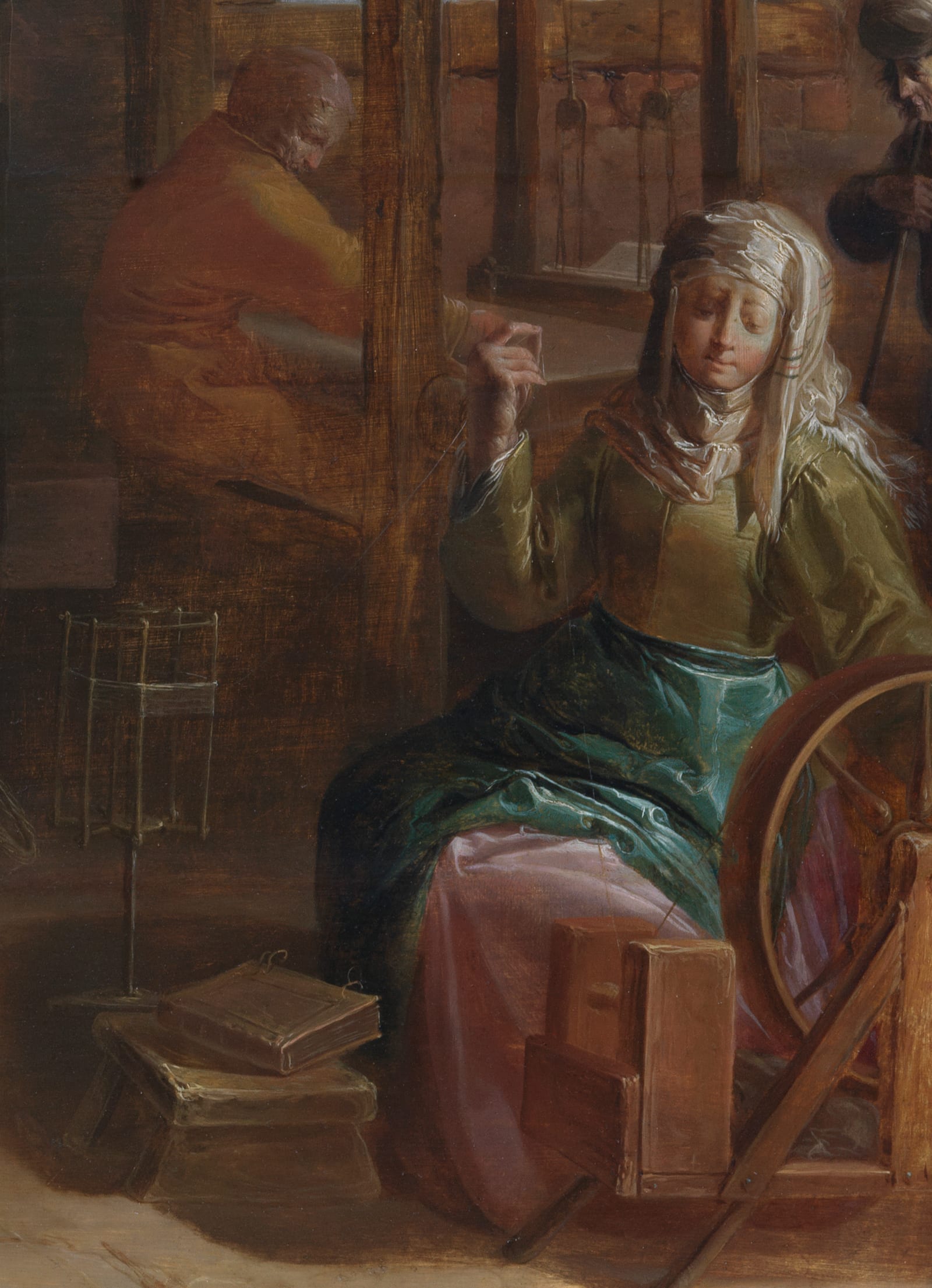
Aquila (Greek Akylas, from the Latin Aquila, 'eagle') was a Jewish tentmaker from Pontus (the Black Sea region of northern Anatolia). His wife Priscilla (Latin diminutive of Prisca) is unanimously presented in the New Testament as a partner of equal standing — Paul names her first in four of the six New Testament passages where they appear together, a striking grammatical irregularity in 1st-century Greek that has been read as Paul's deliberate signaling of her primary role in the couple's ministry.
The couple were among the Jewish-Christian community expelled from Rome by the Emperor Claudius's edict of 49 AD (Acts 18:2; the same edict mentioned by Suetonius as 'expulsion of the Jews on account of Chrestus'). They settled at Corinth, where Paul met them on his first missionary visit; they shared the tentmaking trade with him and provided his lodging, and were instrumental in the foundation of the Corinthian Catholic community.
From around 52 AD they accompanied Paul to Ephesus and remained there as the principal Christian missionary couple of the city for several years. At Ephesus they encountered the young Alexandrian preacher Apollos and 'took him aside and expounded to him the way of God more accurately' (Acts 18:26) — the foundational episode of Christian catechetical formation of a major Pauline collaborator. They later returned to Rome (mentioned in Romans 16:3–5, where Paul greets them in 'the house church that meets at their home' — the first explicit New Testament reference to a Roman house church), then again to Ephesus (2 Timothy 4:19). The catacomb of Priscilla on the Via Salaria in Rome — one of the largest and most important early Christian catacombs, dating to the 2nd century — bears her name and may have begun on land owned by the family.