
Augustine was prior of the Roman monastery of St. Andrew on the Caelian Hill, which Pope Gregory I had founded in his own family's house. In 595 Gregory had seen Anglian slave-boys at the Roman market — 'Non Angli, sed Angeli' ('not Angles but angels') — and resolved to send missionaries to evangelize their homeland.
In 596 Gregory sent Augustine with forty companions across Gaul to Britain. Hearing horrifying tales of the pagan English, Augustine returned to Rome to ask leave to abandon the mission; Gregory refused, with letters of encouragement, and sent him on. Augustine landed at Thanet on the southeast coast of England in 597.
King Ethelbert of Kent — whose Frankish queen Bertha was already a Christian — received the mission cordially, and was baptized himself by Augustine the following year, together with thousands of his subjects. Augustine established his archiepiscopal see at Canterbury, founded the abbey of Sts. Peter and Paul (later St Augustine's Abbey) outside the city walls as his burial place, and laid the foundations of the English Church.
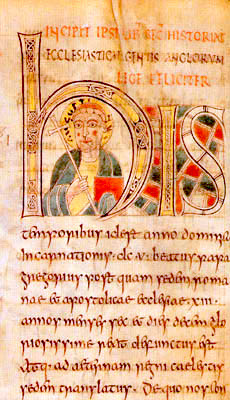
His correspondence with Pope Gregory — preserved by St. Bede the Venerable in the Ecclesiastical History of the English People (731) — contains a series of practical questions about how to organize the new Church, and Gregory's careful answers. These exchanges form one of the foundational documents of English Christianity.