
MIRACULOUS MIRACLES™

Saint — Basil the Great

St. Basil the Great
c. AD 330 — January 1, 379
Father of Eastern monasticism — Doctor of the Church
Cathedral of Caesarea, Cappadocia (Kayseri), Turkey
Feast
January 2 (with Gregory of Nazianzus, Roman); January 1 (Byzantine)
Doctor of the Church
Yes
Life

Basil was the eldest son of a remarkable Christian family of Cappadocia — his father a noted lawyer, his mother Emmelia later venerated as a saint, his elder sister St. Macrina the Younger a spiritual director of remarkable power, his younger brothers Gregory of Nyssa (a Father in his own right) and Peter of Sebaste. Four siblings became saints.

Educated at Constantinople and Athens, where he formed a lifelong friendship with Gregory of Nazianzus, he was on the path to a brilliant secular career when, in 356, he encountered Eustathius of Sebaste and was won to the ascetic life. He visited the monks of Syria, Egypt, Palestine, and Mesopotamia, then withdrew to a wild gorge on the river Iris in Pontus, where he wrote the Rule that would shape Eastern monasticism for all subsequent centuries.

Made bishop of Caesarea in 370, he built outside the city the 'New City' (Basileias) — a vast complex of hospitals, hospices, and homes for the poor that was the model for every medieval European hospital. He successfully defended Nicene orthodoxy against the pro-Arian emperor Valens, organised the response to a great famine, and wrote the Liturgy of St. Basil still used in Eastern churches several times each year. He died at fifty, exhausted by his labours, on the first day of the year 379.

Miracles & Phenomena
  • Confrontation with the Prefect Modestus

    Sent by the Emperor Valens to threaten Basil, the prefect Modestus tried confiscation, exile, torture, and execution. Basil answered: 'Confiscation? I have nothing. Exile? The whole earth is the Lord's. Torture? My body is so weak the first blow would kill me. Death? It would be a kindness — it would unite me sooner to my God.' The astonished prefect reported back to Valens that he could not handle Basil. Valens did not press the matter.

  • The Famine of Caesarea

    During the great Cappadocian famine of 368, Basil sold his inheritance to buy food, founded soup kitchens, and personally served the meals to the poor. The 'Basileias' he afterwards built outside the city — hospitals, hospices, leper homes — was so vast it became a new city.

Relics
  • Bodily relic
    Head of St. Basil
    Great Lavra, Mount Athos, Greece

    His skull is the principal preserved relic, venerated at the Great Lavra on the Holy Mountain.

  • Bodily relic
    Other relics
    Various Greek and Russian monasteries
Iconography
  • Basil in Liturgical Vestments

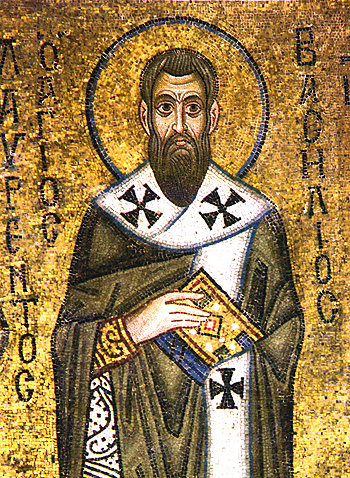
    Depicted as an Eastern hierarch in episcopal vestments, holding the Gospel book or a scroll of his Liturgy. Long brown or grey beard, slight build (he was famously thin). Often paired with Gregory of Nazianzus and John Chrysostom as the 'Three Holy Hierarchs.'

Patronages
CappadociaRussian Orthodox ChurchHospital administratorsReformersLiturgists
Sources & Further Reading