
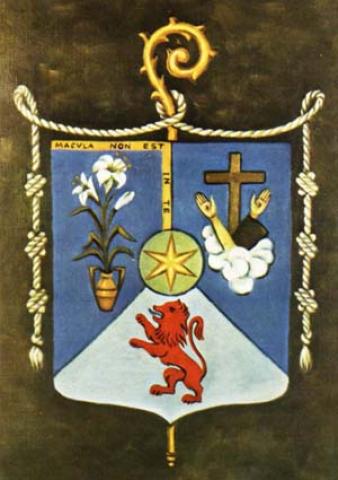
Beatriz da Silva e Meneses was born in Portuguese Ceuta to the noble da Silva family, sister of the future archbishop of Braga, and as a young woman attended at the court of King John II of Castile as lady-in-waiting to his Portuguese-born queen Isabel of Portugal. According to her hagiographers her great beauty drew unwanted royal attention; the queen, in a jealous fit, had her sealed for three days in a chest. From the trial Beatrice emerged determined on religious life.
She entered the Cistercian Royal Monastery of Santo Domingo el Real at Toledo around 1453 as a tertiary boarder, where she lived without taking formal vows for nearly thirty years. In 1484 — finally able to act on a vision she had received decades earlier in which the Virgin promised her the foundation of an order specifically dedicated to her Immaculate Conception — Beatrice and twelve companions left Santo Domingo and founded the new Convent of the Immaculate Conception in Toledo, with the support of Queen Isabel of Castile, who gave them the palace of the Galiana for their use.
Pope Innocent VIII confirmed the new Order of the Immaculate Conception in 1489 — initially under the Cistercian Rule, later (after Beatrice's death) reformulated under the Franciscan observance. Beatrice died at Toledo on August 16, 1492 — a few months before Columbus reached the Caribbean. The Conceptionists became the principal women's religious order specifically dedicated to the Immaculate Conception in the centuries before the formal dogmatic definition of 1854, particularly important in Spain, Portugal, Latin America, and the Philippines. Paul VI canonized her in 1976.