
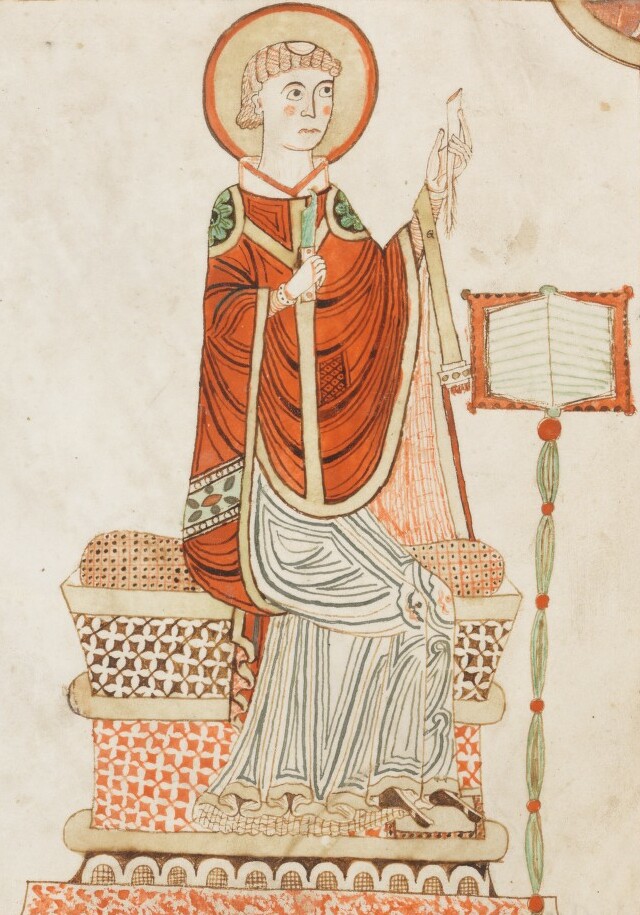
Bede was given at the age of seven to the monastery of Monkwearmouth-Jarrow on the banks of the Tyne in Northumbria, where he remained for the rest of his life. He never travelled further than York. From this single Benedictine library, fed by manuscripts the founder Benedict Biscop had brought from Rome, Bede produced an astonishing range of work: scriptural commentaries, hagiographies, treatises on time-reckoning (his De temporum ratione fixed the AD dating system), homilies, hymns.
His masterpiece, the Ecclesiastical History of the English People (731), is the foundation document of English national identity — a beautifully written narrative from Julius Caesar's invasion to his own day, full of vivid anecdote, careful citation of sources, and theological reflection. It is the first work to use the AD system consistently in narrative.
He died on the eve of Ascension Day, 735, in the midst of dictating the last sentence of a translation of John's Gospel into Old English. His final words, according to his pupil Cuthbert, were 'Consummatum est' ('It is finished'). Pope Leo XIII declared him Doctor of the Church in 1899 — the only Englishman so honoured.