
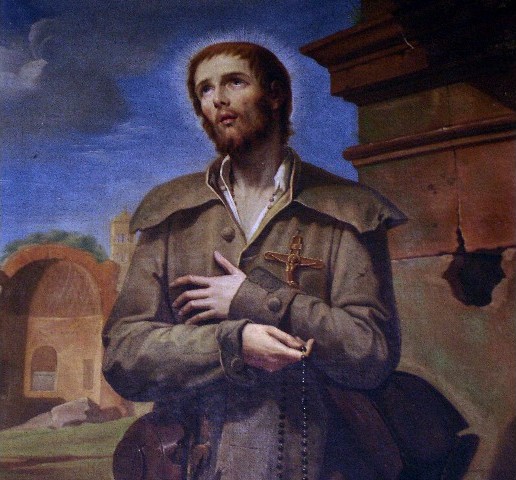
Benoît-Joseph Labre was born to a peasant family in the small Picardy village of Amettes — the eldest of fifteen children. From childhood he was inclined to severe asceticism. At eighteen he successively tried (and was rejected from) the Trappists, the Carthusians, and the Cistercians. The rejections — sometimes for health reasons, sometimes because of his odd manner, but always in some sense for not fitting the institutional life — confirmed him in what became his actual vocation: the lifelong wandering pilgrim, sleeping in church porches and ditches, living entirely on alms, possessing nothing but rosary and a small New Testament.
From 1770 to 1783 he walked the great Catholic pilgrimage roads of Europe — Compostela, Loreto, Assisi, Bari, Einsiedeln, and especially the seven major Roman basilicas. He attended Mass and the Forty Hours' Devotion daily — wherever he was. He spoke as little as possible. He gave away whatever alms he was given that exceeded a single day's bread. He prayed nightly in the Colosseum of Rome. He was famous in his lifetime among the Roman poor for his prophetic insights and his counsels — though he refused all formal status, all entries into religious houses that he was repeatedly offered after his sanctity became known, and any departure from the strict tramp's life.
In Holy Week 1783 he collapsed on the steps of his Trastevere parish church of Santa Maria ai Monti. Brought into a nearby butcher's house, he died there on April 16, 1783 (Wednesday of Holy Week) at thirty-five. The Roman crowd's spontaneous cry at his funeral — 'É morto il santo!' ('The saint is dead!') — became a legendary moment of Roman popular religion. Canonized 1881.