
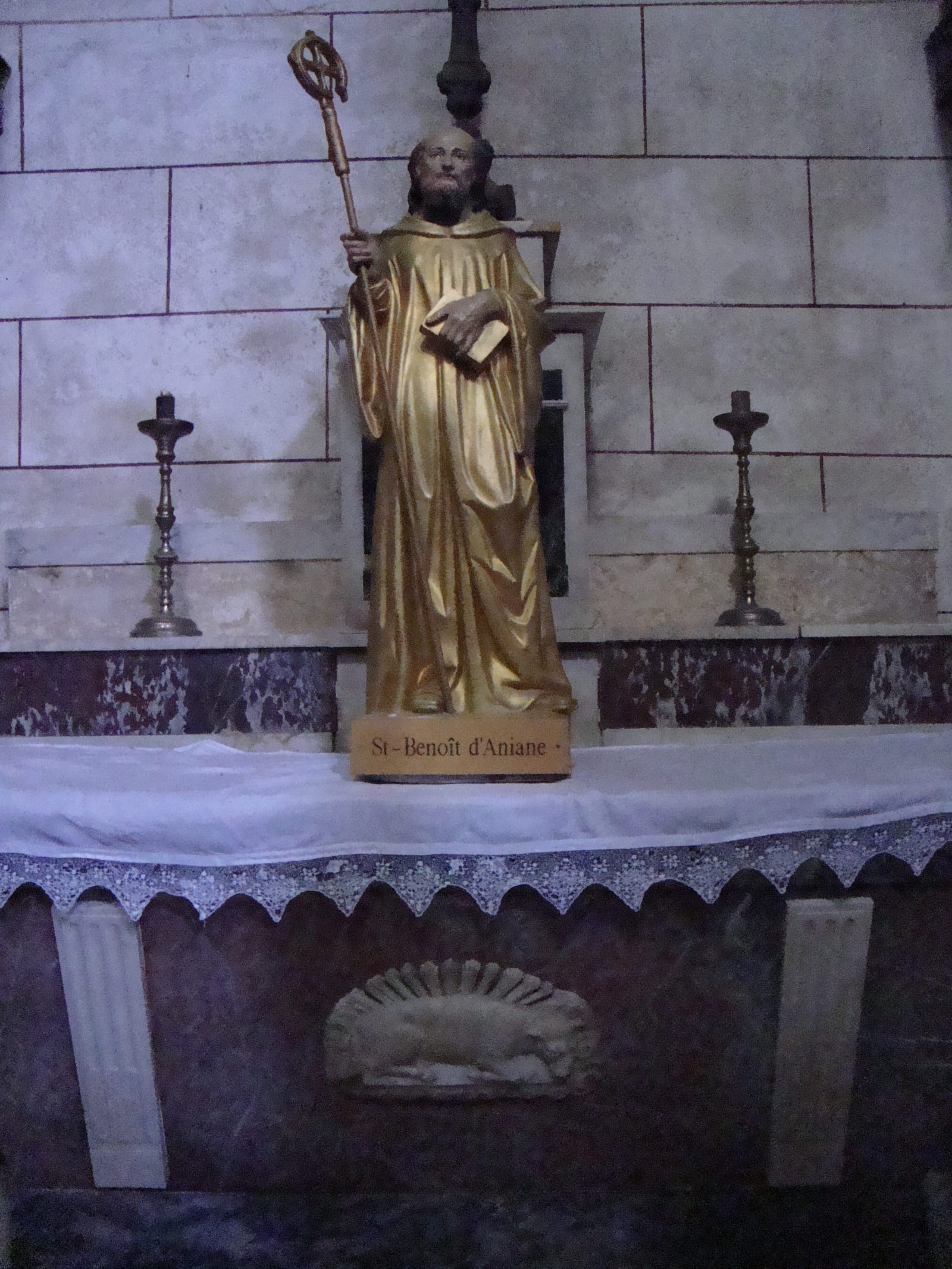
Witiza — son of a Visigothic count of Maguelone in southern Gaul — was a young Frankish nobleman serving in the court of Pippin the Short when his elder brother drowned in front of him while trying to save him. He resolved on monastic life. Taking the name Benedict, he entered the monastery of Saint-Seine, then founded his own community at Aniane around 779.
He emerged as the leading monastic reformer of Charlemagne's empire, then of Louis the Pious's reign. His Codex Regularum (a compendium of every monastic rule he could find) and his Concordia Regularum (a synoptic comparison of them) made the case that the original Benedictine Rule was the ideal common foundation. The Synod of Aachen (817), which he organized for Louis the Pious, imposed a single observance — the Capitulare Monasticum, drawn from his work — on every monastery in the Carolingian empire.
His reforms were the foundation of all subsequent Western monastic renewals — including Cluny (910), Cîteaux (1098), and the Trappists (1664), each of which appealed back to the original Benedict via Benedict of Aniane's mediating synthesis. He died at Aachen in 821 as Louis's chief monastic advisor.