
MIRACULOUS MIRACLES™

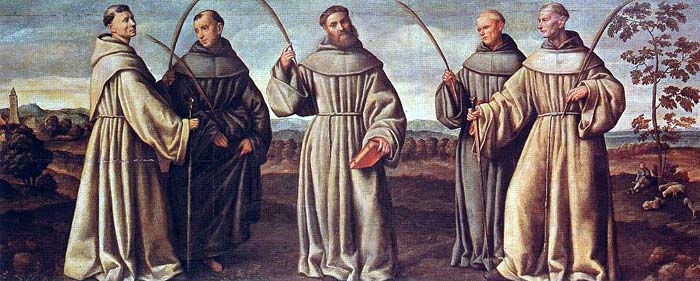
Saint — Sts. Berard of Carbio and Companions (Franciscan Protomartyrs of Morocco)

Sts. Berard of Carbio and Companions (Franciscan Protomartyrs of Morocco)
c. 1180 AD, Carbio, Umbria (Italian noble family) — eldest of the five Franciscan protomartyrs — January 16, 1220 AD, Marrakesh, Morocco — beheaded by the Almohad Sultan Abu Yaqub II (Al-Mustansir), personally by the Sultan
first Franciscan martyrs (1220); protomartyrs of the Franciscan Order
Church of Santa Croce, Coimbra, Portugal — the royal Portuguese basilica that received the relics of the five protomartyrs and that led to the conversion of Fernando Martins de Bulhões (the future St. Anthony of Padua) to the Franciscan Order, Portugal
Feast
January 16
Canonized
Canonized August 7, 1481 by Pope Sixtus IV (the first Franciscans formally canonized as martyrs)
✠ MartyrBeheaded at Marrakesh with his companions — the Franciscan protomartyrs → The Martyrs
Life

St. Francis of Assisi's 1219 meeting with Sultan al-Kamil in Egypt (during the Fifth Crusade at the siege of Damietta) inaugurated the Franciscan mission to the Muslim world — the apostolic commitment of the nascent Franciscan Order to the peaceful evangelical preaching among the Muslim peoples, in deliberate distinction from the contemporary military-Crusade approach.

In 1219, Francis sent a party of six friars to the Almohad Caliphate of Morocco to preach the Catholic Gospel: Berard of Carbio (the leader), Peter of San Geminiano, Adjutus, Accursius, and Otho (the five who would be martyred; a sixth, Vitalis, became ill in Aragon and could not continue).

The five friars travelled from Assisi through Aragon, Portugal (where they rested at the Franciscan foundation), and crossed into Morocco through Ceuta.

Arriving at Seville — then still under Almohad Muslim rule — they began public preaching in the mosque and were expelled by the Muslim authorities. They proceeded to Marrakesh, the Almohad capital, where they preached publicly against Islam and for Christianity in the streets and the public marketplaces.

Repeatedly imprisoned, tortured, and expelled by the Almohad Sultan Abu Yaqub II (Al-Mustansir), the five friars persisted in their public preaching. On January 16, 1220, at Marrakesh, Sultan Abu Yaqub II — in a personal rage — personally beheaded the five friars with his own scimitar.

The Portuguese royal party attending at the Marrakesh court recovered the bodies of the protomartyrs and translated them to Portugal. The relics were received with royal solemnity at the Church of Santa Croce in Coimbra (the royal Portuguese basilica), where they were enshrined for public veneration.

Among the Portuguese witnesses to the Coimbra reception of the protomartyrs' relics was a young Portuguese Augustinian Canon Regular named Fernando Martins de Bulhões (1195–1231) — profoundly moved by the sight of the martyrs' relics, Fernando converted from the Augustinian Canons Regular to the Franciscan Order and took the religious name Anthony (after the Franciscan-Anthonyite chapel at Olivais, near Coimbra). The young Franciscan Anthony of Padua — the future patron of lost articles, preacher, and Doctor of the Church — was institutionally produced by the reception of the Berard-of-Carbio protomartyr relics at Coimbra.

The five protomartyrs were the first Franciscans to be formally canonized as martyrs, by Pope Sixtus IV on August 7, 1481.

Miracles & Phenomena
  • The conversion of St. Anthony of Padua

    The reception of the relics of the five Franciscan protomartyrs of Morocco at the Church of Santa Croce in Coimbra, Portugal, in the spring of 1220 — directly produced the conversion of the young Portuguese Augustinian Canon Regular Fernando Martins de Bulhões to the Franciscan Order under the religious name St. Anthony of Padua (1195–1231, canonized 1232, Doctor of the Church 1946). The Berard-of-Carbio protomartyr witness produced the institutional Catholic saint who would become the most universally-venerated Catholic saint of the Franciscan tradition after St. Francis himself.

  • The Franciscan mission to the Muslim world

    The martyrdom of the five Franciscan protomartyrs at Marrakesh on January 16, 1220 — the first Franciscan martyrdom, initiated by St. Francis's 1219 mission-sending and in continuity with Francis's own 1219 meeting with Sultan al-Kamil at Damietta — institutionally inaugurated the Franciscan mission to the Muslim world. The Franciscan mission continued through the medieval, early-modern, and modern centuries, including the Franciscan Custody of the Holy Land (established 1217 by Francis himself), the Franciscan-Coptic and Franciscan-Islamic evangelical ministries.

Relics
  • Body
    Relics of the Franciscan Protomartyrs
    Church of Santa Croce, Coimbra, Portugal — the relics were received in the royal Portuguese basilica in the spring of 1220; relics also at the Franciscan Basilica of Santa Croce, Assisi, and at the Franciscan houses across the Catholic world

    The principal relics of the five Franciscan protomartyrs rest at the Church of Santa Croce in Coimbra, Portugal — the royal Portuguese basilica in continuous Catholic liturgical use, one of the principal Portuguese Catholic pilgrim destinations and the site of the Anthony-of-Padua conversion.

Iconography
  • The five Franciscan protomartyrs preaching at Marrakesh

    The five Franciscans in Franciscan brown habits in the marketplace of Marrakesh on January 16, 1220, preaching the Catholic Gospel to the Almohad Muslim crowd, the Sultan Abu Yaqub II approaching with the scimitar to personally behead the five friars — the standard Franciscan iconography of the protomartyr witness.

Patronages
Franciscan Order (protomartyrs)Catholic Franciscan mission to the Muslim world (inaugurated by St. Francis's 1219 meeting with Sultan al-Kamil in Egypt)Catholic convert-conscience-formation of St. Anthony of Padua (whose reception of the protomartyrs' relics at Coimbra converted him to the Franciscan mission)