
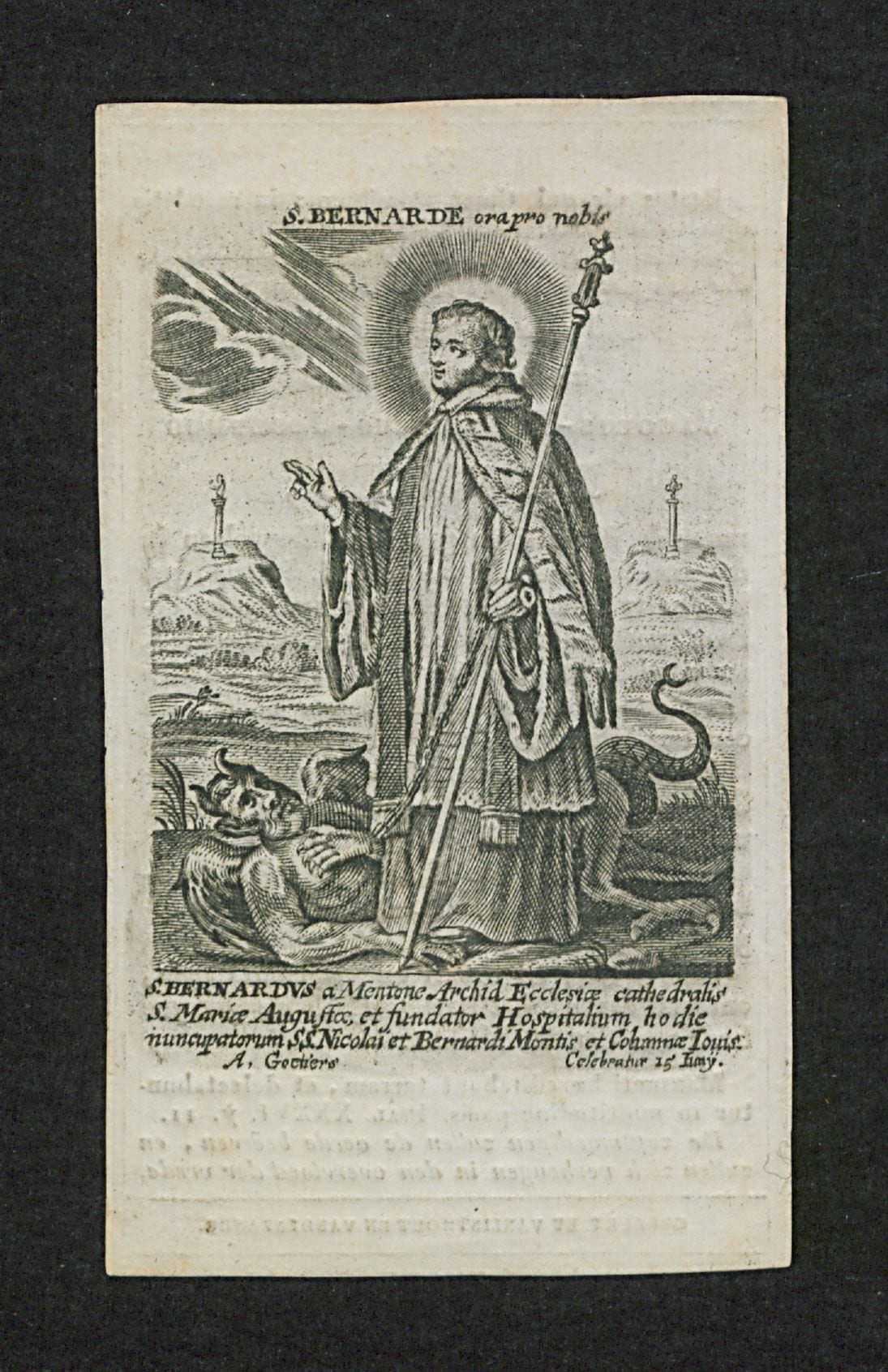
Bernard was born around 1020 at the Château de Menthon on Lake Annecy in Savoy — to a noble Savoyard family of the County of Menthon, one of the principal vassal-families of the House of Savoy.
Refusing the marriage that his parents had arranged, he fled to Aosta in the Italian-side Alps and entered the chapter of secular canons at the Cathedral of Aosta. He rose to be archdeacon of Aosta — the principal pastoral office of the diocese.
His principal pastoral-missionary work was directed at the dangerous Alpine passes between the Catholic Italian peninsula and the Catholic Frankish-Imperial north — the Great St. Bernard Pass (Mons Iovis, 2,469 m, between the Canton of Valais in Switzerland and the Aosta Valley in Italy) and the Little St. Bernard Pass (Alpis Graia, 2,188 m, between the French Savoie and the Italian Aosta Valley).
These Alpine passes were the principal pilgrim and merchant routes between the Catholic regions, crossed by pilgrims, merchants, and imperial-papal diplomats throughout the year — and dangerous: deep snow, avalanches, sudden storms, bandits, and the extreme altitude claimed lives every winter.
Around 1050, Bernard founded the Great St. Bernard Hospice at the summit of the Great St. Bernard Pass — and around 1055 the Little St. Bernard Hospice at the summit of the Little St. Bernard Pass. The two hospices — staffed by the community of canons regular under Bernard's governance — provided shelter, food, medical care, and rescue-services for Alpine travelers, free of charge, in continuous operation through the millennium.
He died at Novara on June 12 or 15, 1081, on a pastoral-diplomatic journey. The Great St. Bernard Hospice survives in continuous Catholic Augustinian Canons liturgical use to the present day — one of the longest continuously-operating mountain hospices in the world.
The famous St. Bernard dog breed — the large mountain-rescue dog famous for the image of the dog carrying the small barrel of brandy around its neck — is bred and trained at the Great St. Bernard Hospice, named for the hospice. The dogs were documented in the 17th century as the principal rescue-instrument of the hospice canons in finding Alpine travelers lost in the snow.