
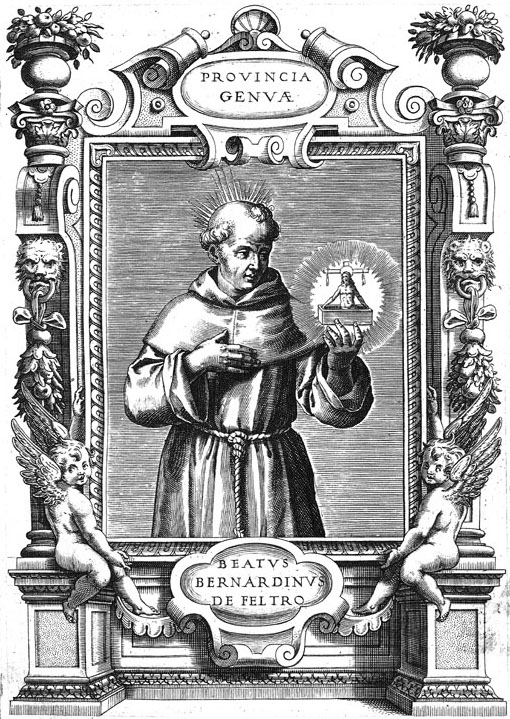
Martino Tomitano was born to a noble family of Feltre in the Veneto and entered the Observant Franciscans at Padua in 1456, taking the name Bernardino in honour of Bernardine of Siena. He was educated at Bologna, ordained priest in 1469, and immediately began his career as a wandering preacher of penitential reform across northern Italy — over thirty Italian cities heard him in his roughly twenty-five preaching years.
His central work was the foundation of Monti di Pietà — the small-loan, low-interest credit institutions that the Observant Franciscans had begun developing from 1462 onward as a Catholic alternative to private money-lending. Where Bernardine of Siena, Antoninus of Florence, and James of the Marches had theorised the institution, Bernardine of Feltre was its most determined practical promoter: he established or supported Monti di Pietà at Mantua (1484), Parma, Pavia, Pisa, Padua, Lucca, Vicenza, Ancona, Perugia, and approximately twenty other Italian cities, raising the necessary capital by his preaching.
His preaching style was vigorous and often physically dramatic (he would publicly burn dice and gaming-tables at the conclusion of his sermons), and his anti-usury campaigns sometimes led to anti-Jewish disturbances — a fact frankly recorded by his contemporary biographers and the subject of careful examination at his beatification in 1654. He died at Pavia on September 28, 1494, and was beatified by Innocent X. His Monti di Pietà institution would survive in Italy for centuries; some persist as charitable foundations to this day, and the Italian banks ('Monte dei Paschi di Siena') derive their name from this tradition.