
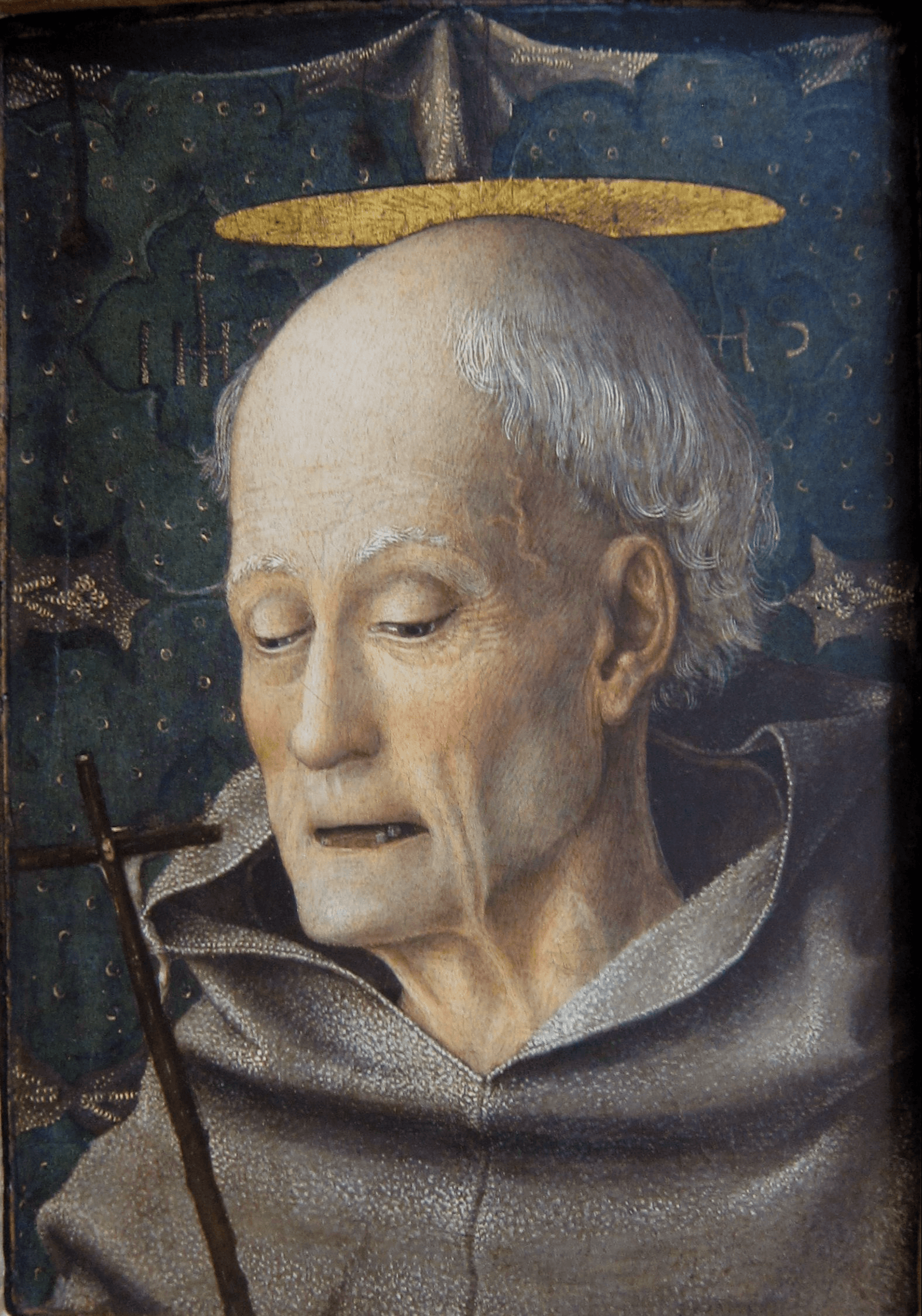
Bernardine degli Albizzeschi was orphaned at six and raised by an aunt in Siena. As a young man he worked in the great Sienese plague hospital of Santa Maria della Scala during the epidemic of 1400 — sleeping there for four months — and contracted the disease himself. On recovering he entered the Observant branch of the Franciscan Order in 1402.
He was the central preacher of the Italian Quattrocento. From around 1417 he travelled the Italian cities preaching at length on the moral reform of urban life: usury, factionalism, witchcraft, sodomy, the public excesses of the wealthy, and the spiritual recovery of the family. His sermons drew enormous crowds — at Florence in 1424, the famous Bonfire of the Vanities preceded the bonfires of Savonarola by sixty-six years. He preached holding up his characteristic tablet bearing the monogram IHS (the Greek abbreviation for Jesus, in gold on a blue background surrounded by sunburst rays) — the icon of his devotion to the Holy Name of Jesus that spread the IHS monogram across Italian Renaissance art and is still embedded in the seal of the Jesuits a century later.
He was accused three times before the Holy See of dangerous innovation in his promotion of the IHS — and three times exonerated by Eugene IV, Martin V, and the canonical examiners. He served as Vicar General of the Observant Franciscans and refused three offered bishoprics (Siena, Ferrara, Urbino). He died at L'Aquila on May 20, 1444, on the road to preach again, and was canonized just six years later by Nicholas V.