
MIRACULOUS MIRACLES™

Saint — Bernward of Hildesheim

St. Bernward of Hildesheim
c. 960 AD, Saxony (noble Saxon family) — November 20, 1022 AD, Hildesheim, Lower Saxony
Bishop of Hildesheim 993–1022; Ottonian-Salian Catholic artist-bishop
Abbey Church of St. Michael (Michaeliskirche), Hildesheim, Germany — his personal foundation; UNESCO World Heritage Site (inscribed 1985, with the adjoining cathedral), Germany
Feast
November 20
Canonized
Canonized 1192 or 1193 by Pope Celestine III
Life

Bernward was born around 960 to a noble Saxon family — educated at the Hildesheim cathedral school under Bishop Osdag and at the royal Ottonian court chapel where he served as tutor to the young Emperor Otto III.

In January 993, with the support of his former student Emperor Otto III and of his former teacher Archbishop Willigis of Mainz, Bernward was consecrated Bishop of Hildesheim — taking up the episcopal governance of the important Lower Saxon Catholic see that had been established by Louis the Pious in 815.

His thirty-year episcopate (993–1022) is distinguished by the establishment of Hildesheim as one of the principal Catholic artistic centres of the Ottonian-Salian period. Bernward — personally accomplished in metalwork, illumination, and architecture — established the episcopal goldsmith's workshop and bronze foundry that would produce the masterpieces of Ottonian Catholic art:

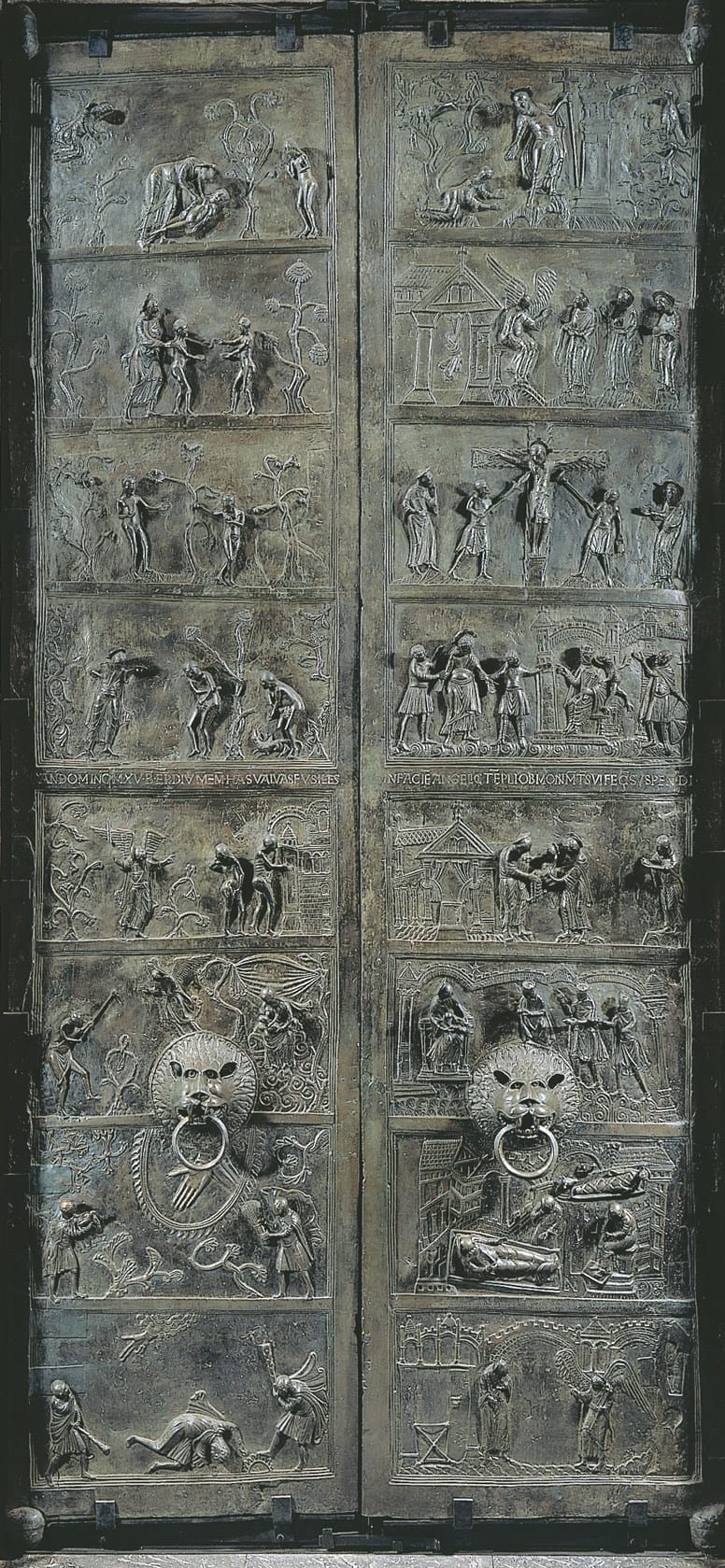
The Bernward Doors (Bernwardstür, c. 1015) — the pair of monumental bronze doors cast in one piece for the entrance of the Hildesheim Cathedral — depicting the scenes of Genesis and the life of Christ in sixteen relief panels, the first large-scale bronze sculpture cast in Europe since Roman antiquity, the principal monument of Ottonian sculpture, surviving in situ at Hildesheim today.

The Bernward Column (Christussäule, c. 1020) — the bronze spiral column modelled on the Roman columns of Trajan and Marcus Aurelius, depicting the scenes of the life of Christ in spiral relief, one of the principal Ottonian sculptural monuments.

He founded around 996 the Abbey of St. Michael at Hildesheim — the Romanesque double-choir cruciform basilica that is the architectural masterpiece of the Ottonian period and an UNESCO World Heritage Site (inscribed 1985, together with the adjoining cathedral). The St. Michael's painted wooden ceiling (the 'Hildesheim Tree of Jesse', c. 1230) survives as the principal medieval painted wooden ceiling in Germany.

Bernward died at his Abbey of St. Michael on November 20, 1022, and was buried in the abbey crypt where his tomb survives today.

Miracles & Phenomena
  • The Bernward Doors of 1015 (Hildesheim Cathedral)

    Bernward's commissioning and personal direction of the casting of the Bernward Doors at the Hildesheim episcopal foundry around 1015 — the first large-scale bronze sculpture cast in one piece in Europe since Roman antiquity — produced the principal monument of Ottonian Catholic sculpture. The doors survive in situ at the western entrance of the Hildesheim Cathedral (rebuilt 1010 by Bernward, destroyed by Allied bombing in March 1945, faithfully restored 1950–1960, re-restored 2010–2014), a UNESCO World Heritage Site since 1985.

  • The Abbey of St. Michael (UNESCO World Heritage)

    Bernward's foundation of the Abbey of St. Michael at Hildesheim (begun 996, consecrated 1022 just before Bernward's death) — the Romanesque double-choir cruciform basilica that is the architectural masterpiece of the Ottonian period — survives as an UNESCO World Heritage Site (inscribed 1985, together with the Hildesheim Cathedral). The church preserves the principal medieval painted wooden ceiling in Germany, a principal monument of Catholic Ottonian-Salian artistic culture.

Relics
  • Body
    Tomb of St. Bernward
    Abbey Church of St. Michael (Michaeliskirche), Hildesheim, Germany — in the western crypt; UNESCO World Heritage Site since 1985; in continuous Catholic liturgical use 1022 to present (with interruption for the 1542 Reformation and the Lutheran-Catholic shared use)

    His tomb in the western crypt of the Abbey of St. Michael at Hildesheim survives in the continuous Catholic liturgical use. The church — severely damaged in the Allied bombing of March 22, 1945, faithfully restored 1950–1960 — remains a UNESCO World Heritage Site and the principal Catholic pilgrim destination of the Lower Saxon Catholic tradition.

Iconography
  • Bernward directing the casting of the Hildesheim Doors

    The late-10th-century Bishop of Hildesheim in episcopal vestments at the episcopal bronze foundry in 1015 directing the casting of the Bernward Doors, the sixteen Genesis-and-Christ-life panel-designs visible on the architectural plan — the iconography of Catholic Ottonian artist-bishop tradition.

Patronages
Diocese of HildesheimLower Saxony and the Northern German Catholic traditionCatholic Ottonian-Salian art and metalwork (especially bronze casting)Catholic architects, sculptors, and craftsmen