
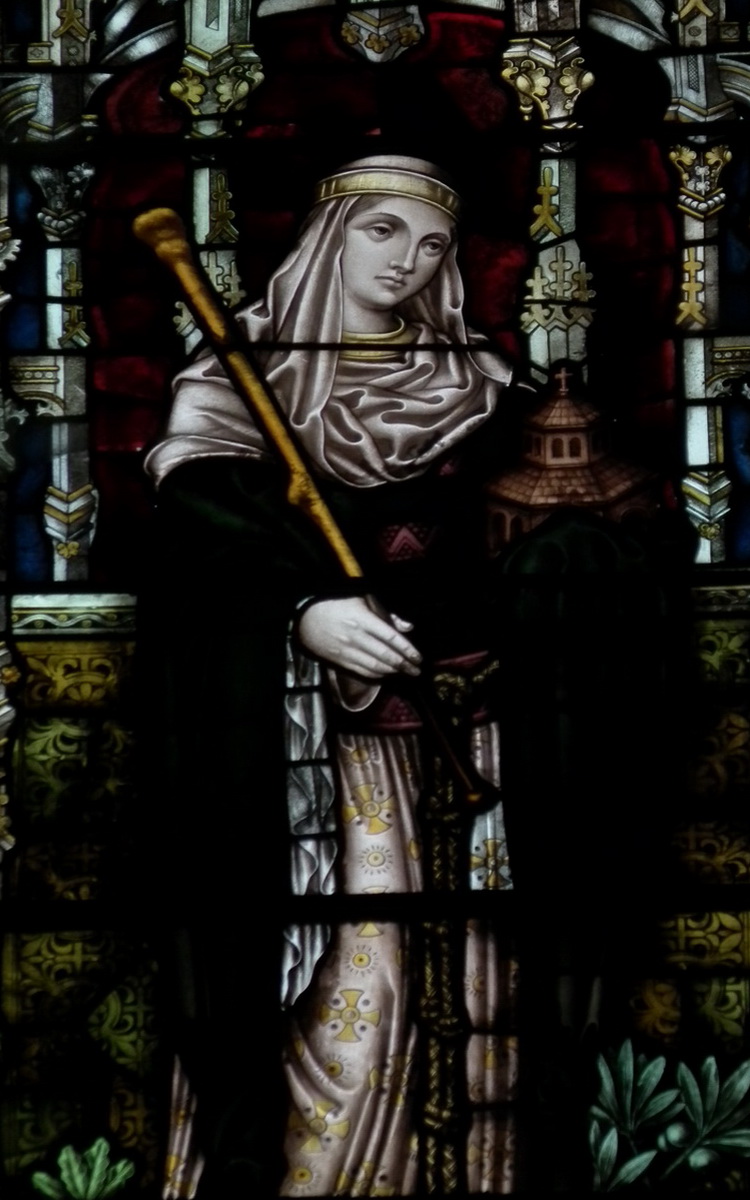
Bertha (Latin Bertha, Anglo-Saxon Beorhte, 'bright') was the daughter of the Frankish King Charibert I of Paris and the Empress Ingoberga. She was raised in the Catholic Christian Frankish court at Paris and Tours.
Around 580 AD — at the age of approximately fifteen — Bertha was given in dynastic-political marriage to the young pagan King Æthelberht of Kent (the most senior of the Anglo-Saxon kings of southeastern Britain). The marriage agreement made by Bertha's Frankish family specifically required that she be permitted to retain her Catholic Christian faith, to bring her personal chaplain (the Frankish Bishop Liudhard), and to have a private Christian chapel at the Kentish royal residence at Canterbury.
Æthelberht agreed to all conditions. Bertha and her chaplain Liudhard established themselves at the small Romano-British ruined church of St. Martin on the eastern outskirts of Canterbury, which they restored and used as the foundational Anglo-Saxon Catholic chapel. The Church of St. Martin at Canterbury — the oldest continuously-used Christian church in the English-speaking world — preserves substantial portions of its 6th-century Bertha-period structure and is one of the foundational pre-Augustinian Catholic sites in Britain.
Bertha's substantial Catholic presence at the Kentish royal court — over the seventeen years between her marriage and the arrival of St. Augustine of Canterbury (see Augustine's entry already in the catalogue) — was the foundational diplomatic-religious context that made possible the 597 Augustine mission. When Pope Gregory the Great organized the Augustinian mission to Britain in 596–597, the route to Kent was politically possible because of Bertha's substantial Catholic-Frankish presence at the Kentish court.
When Augustine arrived at Canterbury in 597, Bertha and Æthelberht received him at the small Church of St. Martin. King Æthelberht was baptized within months (the foundational conversion of Anglo-Saxon England); Bertha's patient seventeen-year-long Catholic witness at the Kentish court is the foundational diplomatic-religious precondition of the Anglo-Saxon conversion. She died around 606 AD and was buried at the small chapel of St. Augustine's Abbey in Canterbury. The Church of St. Martin at Canterbury, the Cathedral of Canterbury (which Augustine founded under her patronage), and St. Augustine's Abbey at Canterbury — the three foundational Anglo-Saxon Christian sites — are collectively a UNESCO World Heritage Site and constitute the foundational shrine-cluster of Anglo-Saxon Catholic identity.