
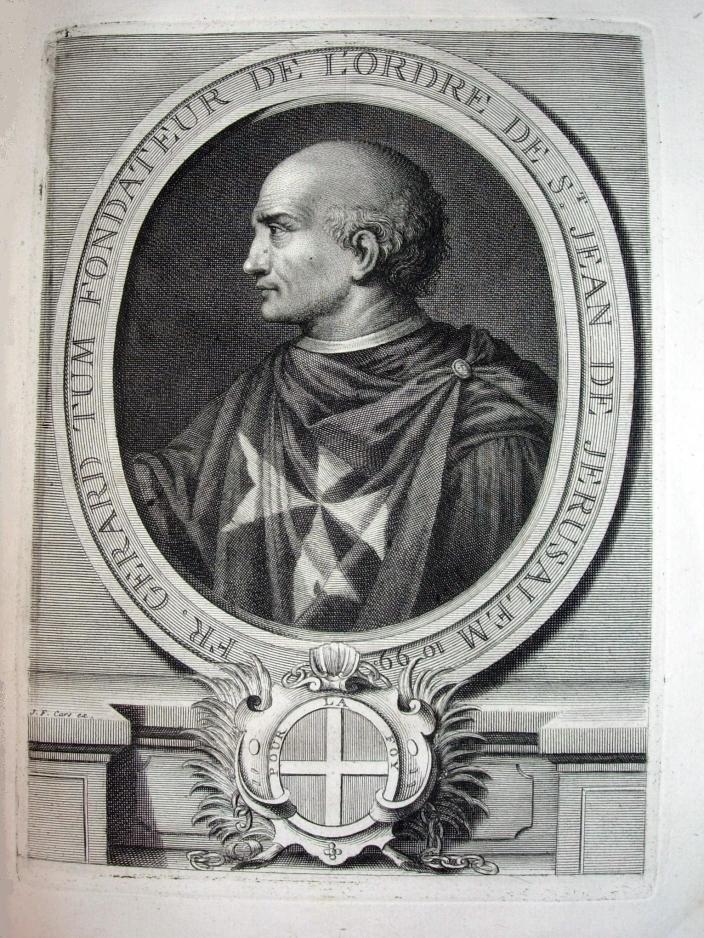
Gerard Thom (Latin Geraldus, Italian Gerardo Sasso, French Gérard le Bienheureux) was born around 1040 — the principal extant tradition placing his birth at Amalfi in southern Italy (the principal late-11th-century mercantile-Catholic city of the Tyrrhenian coast, famous for its trade with the Levant).
Around 1080 — under the sponsorship of the wealthy Amalfitan mercantile community — Gerard established at Jerusalem the Hospital of St. John the Almsgiver (later named Hospital of St. John the Baptist) for the care of the Christian and any-faith pilgrims to the Holy Sepulchre. The hospital was located adjacent to the Church of the Holy Sepulchre in the Christian quarter of Jerusalem.
The hospital was a pre-Crusader institution — operating under the Fatimid Muslim authority of Jerusalem from c. 1080 to the Crusader capture of Jerusalem on July 15, 1099. After the Crusader establishment of the Latin Kingdom of Jerusalem, the Hospital received massive endowments from the Crusader nobility — most including the famous royal donations of Godfrey de Bouillon and his brother Baldwin I.
On February 15, 1113, Pope Paschal II formally recognized the Hospital of St. John in the papal bull Pie postulatio voluntatis — institutionally establishing the Hospital community as a papally-recognized Catholic religious order, exempt from local episcopal jurisdiction and placed under the direct authority of the Apostolic See. The Pie postulatio voluntatis is the founding charter of the Knights Hospitaller / Sovereign Military Order of Malta.
Gerard governed the Hospital from 1080 to his death on September 3, 1120 — a forty-year tenure as the founder-master of the order. His successor Raymond du Puy (1120–1160) would militarize the Order, adding the military-knightly dimension to the hospitaller-medical core that Gerard had established.
The Sovereign Military Order of Malta — the continuing institutional descendant of Bl. Gerard's 11th-century Jerusalem hospital — survives today as one of the oldest continuously-functioning Catholic religious-and-chivalric orders (founded c. 1080, papally recognized 1113, still operating to the present day, over 940 years of continuous Catholic institutional existence). The Order maintains diplomatic relations with 110 countries, observer status at the United Nations, and operates massive humanitarian and healthcare missions in 120 countries worldwide.