
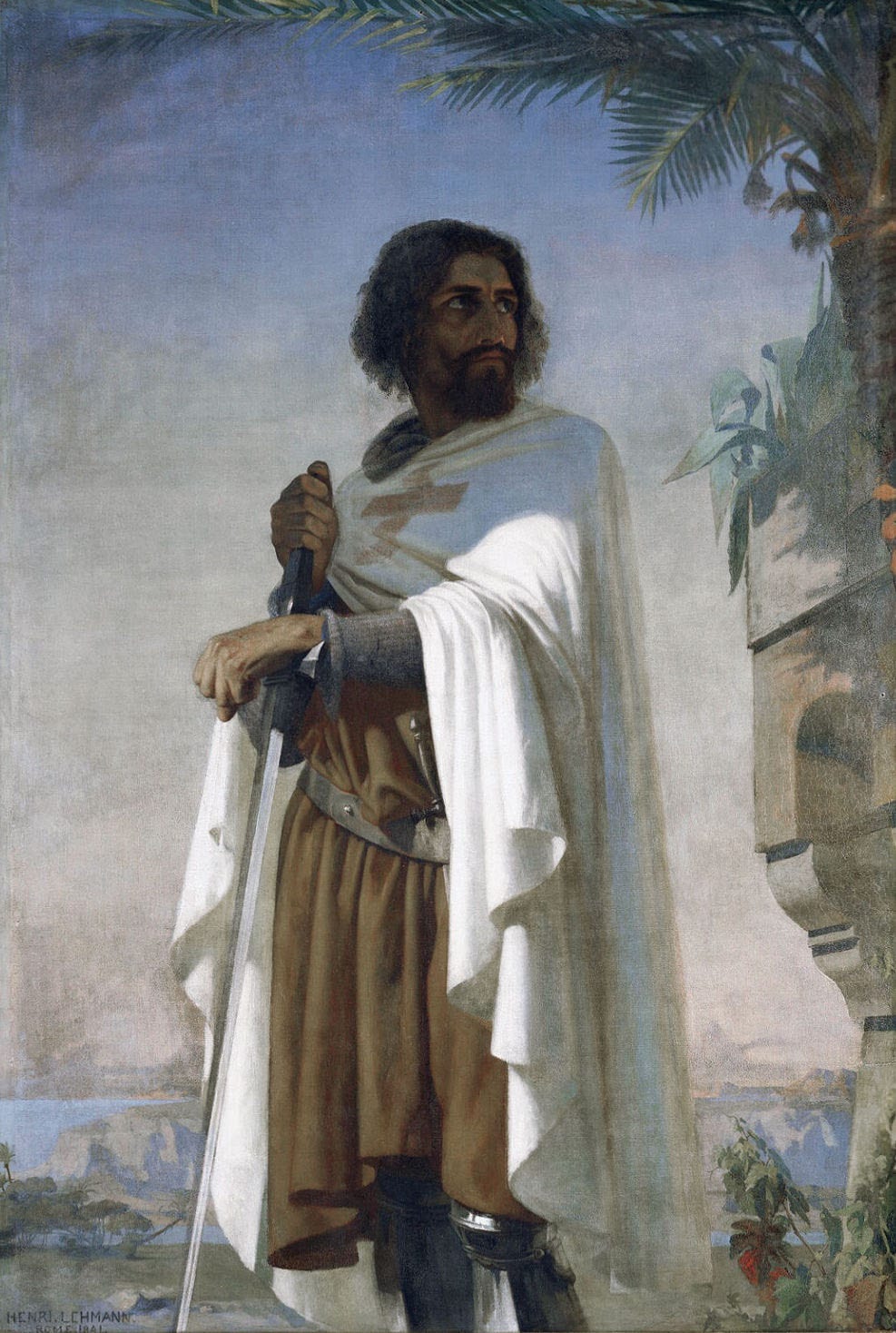
Hugh was born around 1070 to a noble Champenois family at Payns on the Seine river near Troyes — vassals of the Counts of Champagne, one of the principal feudal regions of the Capetian French kingdom.
After military service in the early 12th century, Hugh joined the First Crusade or its immediate aftermath, arriving at Jerusalem in the early years of the new Crusader Kingdom (the Latin Catholic monarchy established at Jerusalem 1099 after the Crusader capture of the city).
Around 1119 — the date traditionally placed as Christmas Day 1119 at the Church of the Holy Sepulchre — Hugh of Payns and eight companion-knights (Godfrey of Saint-Omer, Payen de Montdidier, Archambaud de Saint-Aignan, André de Montbard, Geoffrey Bisol, Roland, Gondemar, and one unnamed) took the triple monastic vows of poverty, chastity, and obedience before King Baldwin II of Jerusalem and Patriarch Warmund of Picquigny — institutionally founding the Poor Fellow-Soldiers of Christ and of the Temple of Solomon (Latin Pauperes commilitones Christi Templique Salomonici, known to history as the Knights Templar).
King Baldwin II granted the new Order the housing in his royal palace at the Al-Aqsa Mosque on the Temple Mount (which the Latin Crusaders identified as the former Temple of Solomon) — giving the Order its permanent name as the 'Knights of the Temple' or 'Templars'.
The Order's apostolate was the protection of Christian pilgrims travelling between the coast (the port of Jaffa) and the Holy Sepulchre at Jerusalem along the dangerous pilgrim-roads of the Crusader Kingdom — a distinctive synthesis of knighthood with monastic vows that institutionally inaugurated the medieval military-religious order tradition that would produce the Hospitallers (militarized 1136), Teutonic Knights (1190), Knights of Calatrava, Knights of Santiago, and the entire medieval military-religious order family.
In 1127 Hugh travelled to Europe to seek papal recognition of the new Order. At the Council of Troyes in January 1129 — convened by the papal legate Cardinal Matthew of Albano and presided over by Hugh of Payns himself — the Templar Order was formally recognized by the Catholic Church; the Rule of the Templars (composed by St. Bernard of Clairvaux at Hugh's request, drawing on the Benedictine Rule and the Cistercian discipline) was approved.
Bernard of Clairvaux composed his famous De Laude Novae Militiae ('In Praise of the New Knighthood', c. 1130) — the theological-pastoral charter of the Templar Order, articulating the specifically Catholic synthesis of monasticism with warfare against infidel enemies in the defence of Christian pilgrims and the Holy Land sites.
Hugh returned to Outremer and governed the Templar Order until his death around May 24, 1136. His successor Robert de Craon would further establish the Order. The Templar Order grew through the 12th and 13th centuries into the principal military-religious order of the Crusader Kingdom, accumulating massive landed estates across Catholic Europe — until the famous suppression of the Order by Pope Clement V (under pressure from King Philip IV of France) at the Council of Vienne in 1312, the famous Templar trials and executions (1307–1314) including the martyrdom of Grand Master Jacques de Molay (1314).