
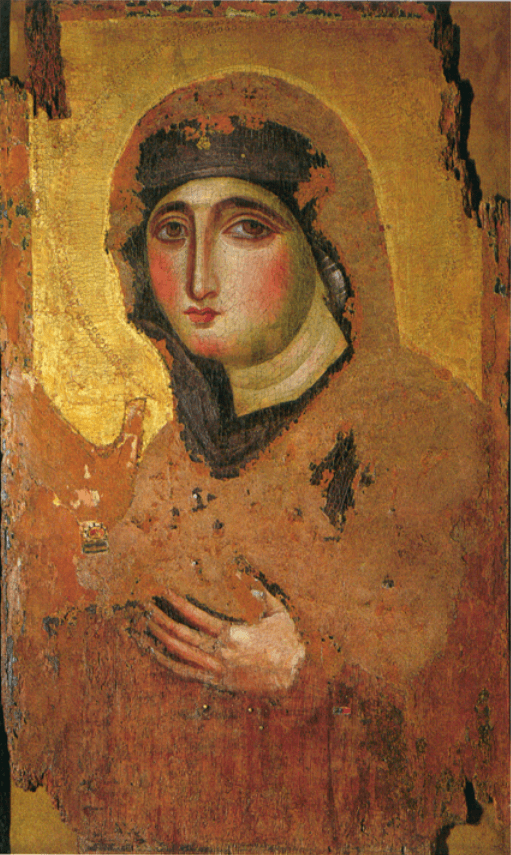
The Blessed Virgin Mary was conceived without original sin (the Immaculate Conception, defined as dogma by Bl. Pius IX in 1854). Born to Sts. Joachim and Anne by Catholic tradition, she was presented in the Temple at three and grew in the grace of God. Espoused to Joseph of the house of David, she received the Annunciation of the Archangel Gabriel at Nazareth — and by her fiat, 'Be it done unto me according to thy word' (Lk 1:38), the Word became flesh in her womb.
She bore Christ at Bethlehem, presented Him in the Temple, fled with Him into Egypt, raised Him at Nazareth, and accompanied Him through His public ministry. At Cana she obtained His first miracle by her intercession. At Calvary she stood beneath the Cross while a sword pierced her own soul (Lk 2:35); the Lord entrusted her to St. John, and through John to the whole Church.
She was present with the Apostles at Pentecost, the Mother of the new-born Church. At the close of her earthly life she was assumed body and soul into heaven (defined as dogma by Pius XII in 1950) and crowned by the Most Holy Trinity as Queen of Heaven and Earth.
She is the most-venerated saint in the Church's history. The Roman Calendar marks fifteen feasts and solemnities of her; the Rosary is built around the mysteries of her Son seen through her eyes; the great Marian shrines — Guadalupe, Lourdes, Fátima, Czestochowa, Loreto, Aparecida — receive tens of millions of pilgrims each year. Hers is the only human heart, beside that of her Son, in which sin has never reigned.