
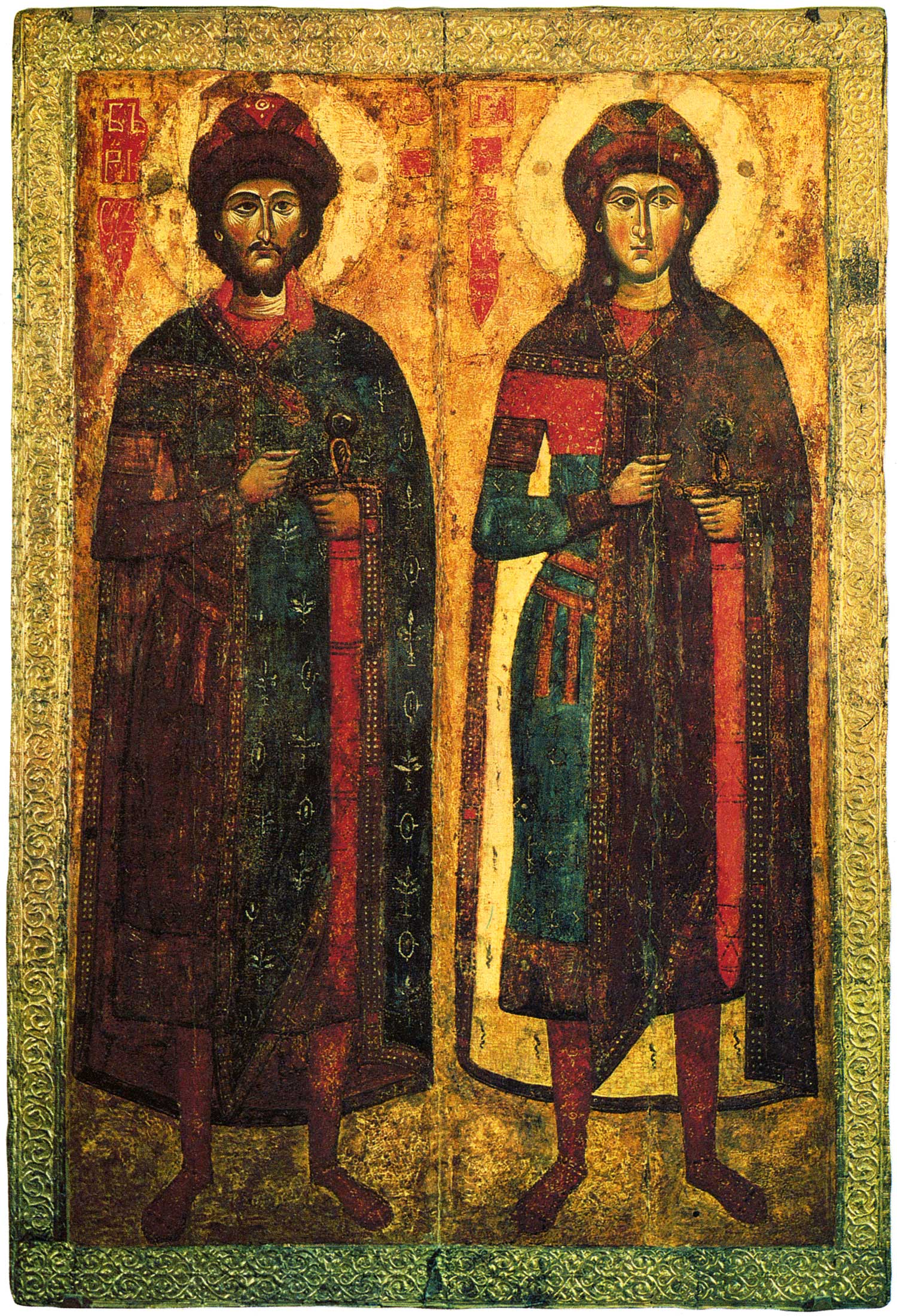
Boris and Gleb were the younger sons of St. Vladimir the Great of Kiev (the baptizer of Kievan Rus' in 988) and his wife Anna Porphyrogenita (the Byzantine imperial princess, sister of Emperor Basil II 'the Bulgar-Slayer'). They were raised at the royal Kievan court in the first generation of Catholic-Orthodox Christianity in Kievan Rus'.
On the death of Vladimir on July 15, 1015, the Kievan succession crisis erupted: Vladimir's eldest surviving son Svyatopolk Vladimirovich (called by Russian tradition 'Svyatopolk the Accursed' / Svyatopolk Okayanny) seized the Kievan throne and launched a systematic campaign of fratricide to eliminate his younger half-brothers.
Boris — returning from a military campaign against the Pechenegs, accompanied by his personal druzhina retinue — received word that Svyatopolk's assassins were hunting him. His retinue offered to march on Kiev to contest the throne; Boris refused, declaring (in the famous words preserved in the Primary Chronicle): 'It cannot be that I should lift my hand against my elder brother. If my father is dead, let this one be in his place as my father.'
On July 24, 1015, the Varangian assassins of Svyatopolk found Boris's encampment near the river Alta; Boris spent the night in prayer; in the morning, after celebrating the Eucharist, he was stabbed to death in his tent.
Gleb — younger, summoned from Murom to Kiev by Svyatopolk's deceitful invitation — was intercepted on the Smyadyn river near Smolensk on September 5, 1015, by Svyatopolk's assassins. His own cook Torchin cut his throat with a kitchen knife. Gleb's dying words (per the Primary Chronicle): 'You who slay me, brothers, do not slay me. I am ready to do everything. Spare my youth!'
The sanctity of the two brothers — martyred not for the Catholic Christian faith but for their refusal to take up arms against their elder brother in the fratricidal Kievan succession war — was immediately recognized by the Kievan Catholic-Christian community. The distinctive Russian-Slavic Catholic-Orthodox saint-category of 'passion-bearers' (strastoterptsy) — saints martyred not for the faith directly but for the Christ-like acceptance of unjust death — was instituted at the canonization of Boris and Gleb in 1071.
Their original tomb at Vyshhorod near Kiev became the principal Kievan pilgrim destination; their cult rapidly spread throughout the entire Russian-Ukrainian-Belarusian Catholic-Orthodox world, with Boris-and-Gleb churches and monasteries founded across the Slavic East throughout the medieval centuries.