
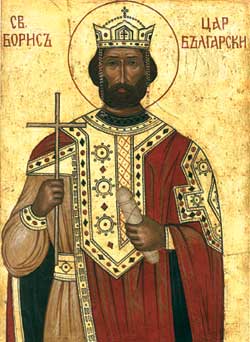
Boris was Khan of the Bulgars from 852. After military defeats by Byzantium in 864 and the threat of famine, he asked for Greek missionaries; in 864 he and his court were baptized at Pliska, taking the Christian name Michael in honor of his godfather Emperor Michael III.
He used his early correspondence with Pope Nicholas I (the Responsa ad Bulgaros) to negotiate the religious independence of his new Christian kingdom against both Frankish-papal and Byzantine ecclesiastical ambitions. Ultimately, in 870 — after the Eighth Ecumenical Council formally restored Bulgaria to the Constantinopolitan jurisdiction — he aligned the Bulgarian Church definitively with the Byzantine tradition.
His foundational genius was to welcome the disciples of Sts. Cyril and Methodius expelled from Moravia in 885 — Clement, Naum, Gorazd, Sava, and Angelar — into Bulgaria and to establish at Preslav and at Ohrid the great schools at which the Slavonic liturgy and the Cyrillic alphabet (developed by Clement of Ohrid from Cyril's Glagolitic) took permanent form. Through Boris, the work of the Thessalonian brothers passed from a failed Moravian mission into the permanent literary culture of Eastern Europe.
He abdicated in 889 to enter the monastery of Preslav, where he lived eighteen more years until his death in 907. The Eastern Orthodox, Catholic, and Bulgarian Patriarchal calendars all keep his feast.